What is Surah Nas about? Surah Nas is the 114th and final chapter of the Quran, containing 6 verses. It is a short but powerful supplication in which Allah commands the believer to seek refuge in three of His greatest attributes—Lord, King, and God of mankind—from the most dangerous enemy: the whisperer (Al-Waswas) who plants evil thoughts and doubts into the human heart, whether that whisperer is from the jinn or from other human beings. Surah Nas is one of the last surahs ever revealed to the Prophet ﷺ, and together with Surah Al-Falaq, it forms the most powerful protection recited by Muslims every day.
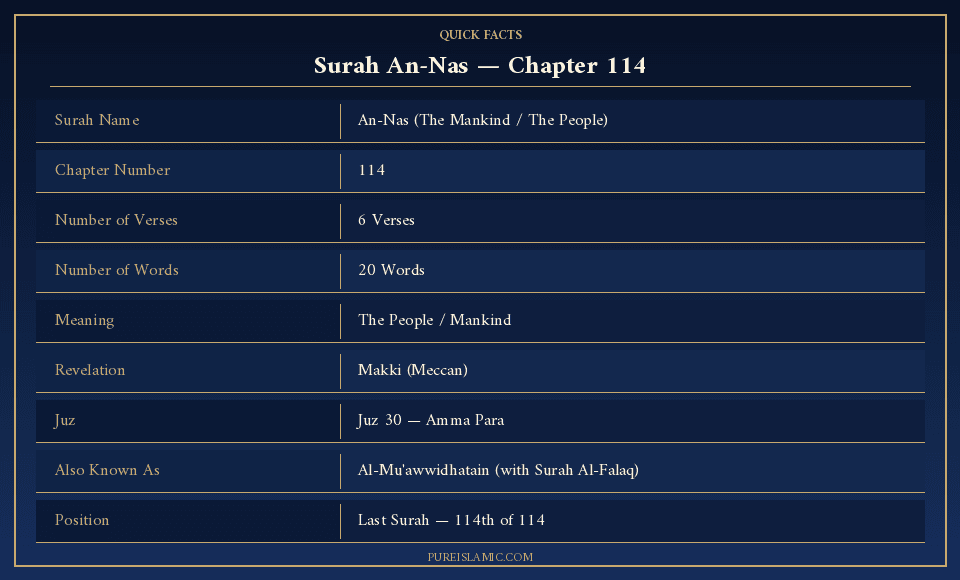
Quick Facts About Surah Nas
| Detail | Information |
|---|---|
| Surah | An-Nas |
| Chapter Number | 114 |
| Verses | 6 |
| Words | 20 |
| Meaning | The Mankind / The People |
| Revelation | Makki (Meccan) — final revelation period |
| Juz | 30 (Amma Para) |
| Arabic Name | النَّاس |
| Also known as | Al-Mu’awwidhatayn (with Surah Al-Falaq) |
| Position | Last surah of the Quran |
What Does An-Nas Mean?
An-nas (النَّاس) certainly approximates “men” or “man.” It is one of the most frequently used words in the Arabic Qur’an—and it appears in almost every verse of Surah Nas, creating effective rhythmic repetition This repetition is deliberate: it emphasizes that without exception all of humanity is susceptible to hostile whispers.
Importance and Virtues of Surah An-Nas
Surah An-Nas holds a special place among the chapters of the Quran. It is one of the two Mu’awwidhatayn (Surah Al-Falaq and Surah An-Nas), which the Prophet Muhammad ﷺ regularly recited for protection from all forms of evil.
‘Uqbah ibn ‘Amir (RA) reported that the Messenger of Allah ﷺ encouraged the recitation of Surah Al-Falaq and Surah An-Nas as among the best chapters for seeking Allah’s protection.
Abdullah ibn Khubaib (RA) narrated that the Prophet ﷺ said the following:
“Recite Surah Al-Ikhlas, Surah Al-Falaq, and Surah An-Nas three times in the morning and three times in the evening. They will suffice for you against everything.”
(Sunan Abu Dawud 5082; Jami’ at-Tirmidhi)
Aisha (RA) also reported that whenever the Messenger of Allah ﷺ became ill, he would recite Surah Al-Ikhlas, Surah Al-Falaq, and Surah An-Nas, then blow over himself. During his final illness, she recited them for him and wiped his body with his own hands, seeking their blessing. (Sahih al-Bukhari)
These authentic narrations highlight the great virtue of Surah An-Nas and its importance as a means of seeking Allah’s protection from evil, harm, and the whispers of Shaytan.
Surah Nas Arabic Text (Full 6 Verses)
بِسْمِ اللَّهِ الرَّحْمَٰنِ الرَّحِيمِ
- قُلْ أَعُوذُ بِرَبِّ النَّاسِ
- مَلِكِ النَّاسِ
- إِلَٰهِ النَّاسِ
- مِن شَرِّ الْوَسْوَاسِ الْخَنَّاسِ
- الَّذِي يُوَسْوِسُ فِي صُدُورِ النَّاسِ
- مِنَ الْجِنَّةِ وَالنَّاسِ
Surah Nas Transliteration
Bismillahir Rahmanir Raheem
- Qul a’udhu bi-rabbin-nas
- Malikin-nas
- Ilahin-nas
- Min sharril waswasil-khannas
- Alladhi yuwaswisu fi sudurin-nas
- Minal-jinnati wan-nas
Surah Nas English Translation
In the name of Allah, the Entirely Merciful, the Especially Merciful.
- Say: I seek refuge in the Lord of mankind.
- the King of mankind,
- the God of mankind,
- from the evil of the retreating whisperer —
- who whispers into the hearts of mankind,
- from among the jinn and mankind.
Surah Nas Tafseer & Explanation (Verse by Verse)
Verses 1–3: The Three Attributes of Allah—the Three Shields.
Surah Naas opens with a direct command from Allah—the family (say)—guiding the Prophet ﷺ and striving for every believer to actively and consciously seek a safe haven. This is not passive security; it’s far from a statement made with focus and purpose.
Allah then offers His 3 attributes as the foundation of this refuge—Allah, the triple protector:
Rabb an-Nas (Master of Mankind): It is Rabb who creates, feeds, nourishes, and takes care of all desires. To find a safe haven in the form of Allah’s robe and place yourself under the care of the One who controls your entire lifestyle—your body, your provisions, and your very heartbeat.
Malik an-Nas (King of Mankind): The absolute sovereign of the Malik Law—one who has full authority and power over all people. No king, ruler, authority, or power has authority that is not always in a prolonged state of the kingship of Allah. Lightning is common and absolute on every whisper—human or jinn—to seek safe refuge in the form of Allah’s Malik.
Ilah an-Nas (Man’s God): Ilah is the way and the only one worthy of worship and universal submission. This virtue strengthens the two primary ones: the most effective, who can give complete surrender to the Lord, the King, and God mixed. No created being—no saint, no shrine, no amulet—can update this threefold protection.
According to Ibn Kathir, Allah mentions three of His beautiful attributes in Surah An-Nas: Rabb (Lord), Malik (King), and Ilah (God). Through these names, Allah teaches believers to seek refuge in Him alone from the evil of the whisperer (Shaytan), who constantly tries to mislead people and lead them away from the path of righteousness.
Verse 4: Al-Waswas Al-Khannas The fourth verse is al-waswas al-khannas—the suspended whisper.
This is one of the most specialized descriptions in the entire Quran. Enemy names given:
al-wasah — from waswasah, from speech with a faint, repetitive whispering sound. It describes someone whispering constantly, constantly, over and over—planting seeds of doubt, choice, distraction, and sin, one smooth offering at a time.
Al-Khannas—From Khunos, it means “withdrawn,” “slink back,” or “withdrawn.” This describes the characteristic behavior of Satan: when Allah is remembered, he retreats and hides, then sneaks back when a man or woman becomes careless once more. The Prophet ﷺ defined this precisely: Satan sits in the coronary heart of the Son of Adam. When Allah is remembered, he runs away. When the memory stops, it comes back to whisper.
Therefore, the most powerful defense against unmarried whispers of Satan is zikr—regular reminders of Allah. Sura Nas teaches us to strive to seek refuge and preserve the memory that Al-Khannas has no opportunity to go back.
Verse 5: Whispering in the hearts (far away)
“He who whispers in the hearts (far away) of mankind.” The Arabic phrase “sudur” (plural of “sadr”) refers to the chest—the region closest to the heart. This is enough: the whisperer no longer invades the first frame, the bank account, or popularity. Goal number one is consistently the heart — the seat of language, faith, love, and desire.
Whispers that settle through this channel include:
Doubting one’s lifestyle or Allah’s mercy
Excessive guilt designed to make a person stop feeling regret
pride and arrogance that at some stage enters into acts of worship
With prayer, the entire mind is distracted
I wish they would normalize sin step by step
suspected of various Muslims harming the brotherhood
Verse 6: From the jinn and man.
“From some jinn and human.” This very last verse shows something profound—whispering is not always most effective from jinn (Shaytan and his forces) but more so among people. Bad associations, toxic environments, people who normalize sin, material content that pollutes thoughts with ploys—these are all kinds of human whispers that Surahanas guards against
This makes Surah Naas the most complete surah of assurance: it includes every unseen whisper (from Shaytan) and visible whispers (from humans and environments).
The story of Surah An-Nas and the magic cast on the Prophet ﷺ
According to actual Islamic histories, Surah An-Nas and Surah Al-Falaq were revealed for the period during which Prophet Muhammad ﷺ suffered from magical illness by Labid Ibn Al-A’sam. During this time, Allah was a way of seeking His protection and restoration. The Prophet (peace and blessings be upon him) recited these surahs and relied on them to protect himself from all kinds of errors.
This incident highlights the importance of Surah An-Nas for effectively seeking protection from Allah from harm, whispers of Satan, and all forms of evil. It further indicates that ultimate safety and recovery comes from Allah Himself.
References
- Sahih al-Bukhari, Book of Medicine (Kitab al-Tibb), Hadith 5763, 5765, 5766.
- Sahih Muslim, Book of Greetings (Kitab al-Salam), Hadith 2189.
- Tafsier Ibn Kathir, Commentaries on Surran Falak (113) and Surran An-Nas (114).
Surah Nas vs. Surah Al-Falaq—What’s the Difference?
Both surahs are called Al-Mu’awwidhatain (the Two Protections) and are always recited together. But they protect from different threats:
| Surah Al-Falaq (113) | Surah Nas (114) | |
|---|---|---|
| Seeks refuge in | Lord of the Daybreak | Lord/King/God of Mankind |
| Protects from | External evils: darkness, magic, envy | Internal evils: whispers into the heart |
| Threat source | General evil of creation, night, witchcraft, envious people | The whisperer (Shaytan + evil people) |
| Focus | Outside threats | Inside the heart |
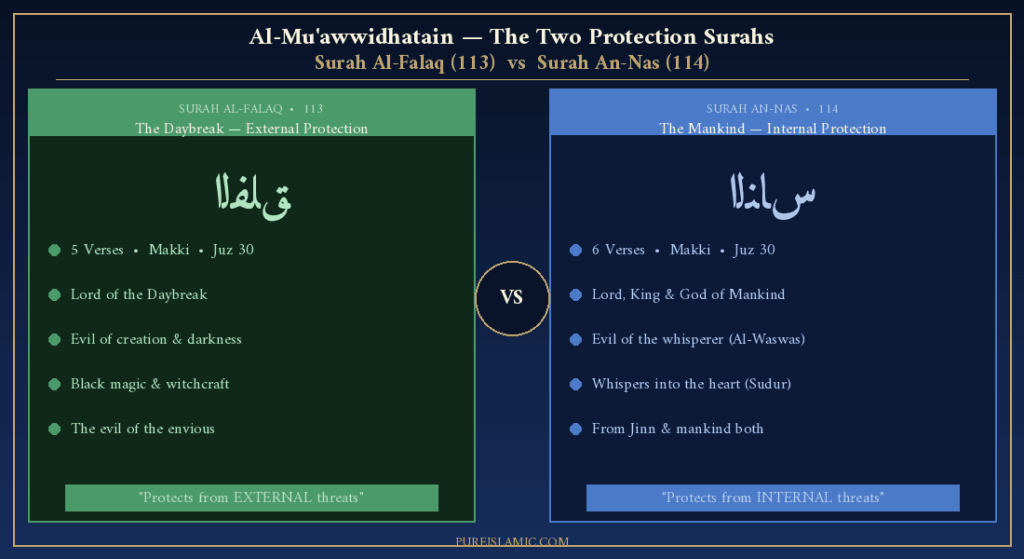
Together they form a complete shield: Al-Falaq protects from what attacks from outside, and Surah Nas protects from what attacks from within.
Surah Nas as a Framework for Tazkiyah (Self-Purification)
Scholars have mentioned that the 3 attributes of Allah mentioned in Surah Naas correspond to the 3 dimensions of a person seeking protection:
Rabb (Lord/Nurturer) — Protects the frame and physical boundary from corruption
Malik (King/Authority)—Protects thoughts and desires from being controlled by Satan using his power
Ilah (God/Worshipper)—Protects the soul and what is associated with pure worship from being contaminated by shirk or hypocrisy
In this study, Surah Nas is not always just a prayer—it is a complete map by miles of what should be included in every human being.
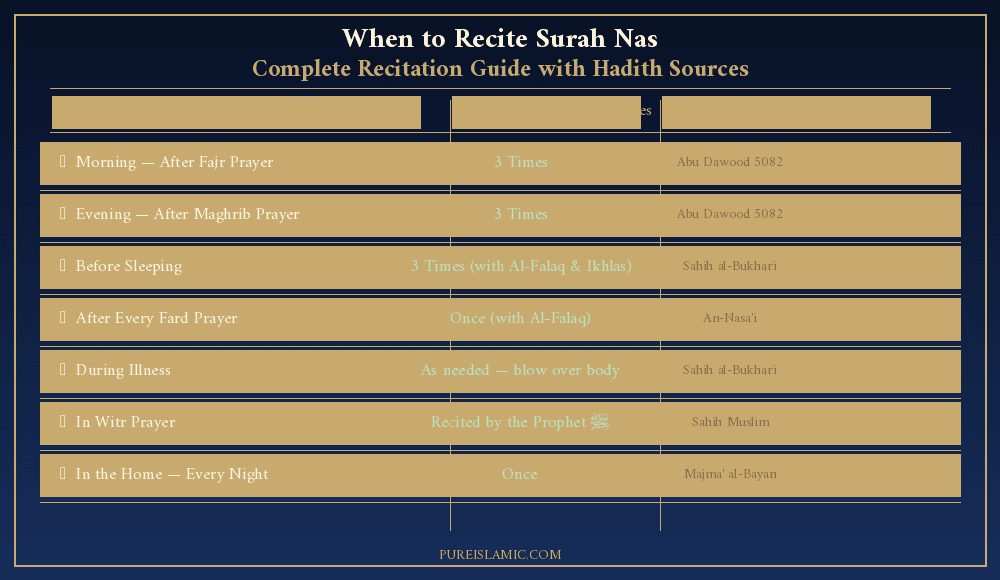
When to Recite Surah Nas
| Time | How Many Times | Source |
|---|---|---|
| Morning (after Fajr) | 3 times | Abu Dawood 5082 |
| Evening (after Maghrib) | 3 times | Abu Dawood 5082 |
| Before sleeping | 3 times (with Al-Falaq and Al-Ikhlas) | Sahih al-Bukhari |
| During illness | As needed (blow over body) | Sahih al-Bukhari |
| After every Fard prayer, | Once (with Al-Falaq) | An-Nasa’i |
| In Witr prayer | Recited by the Prophet ﷺ | Sahih Muslim |
| In the house every night | Once | Majma’ al-Bayan |
Main Themes of Surah Nas
1. Complete dependence on Allah—Lord, king, and God: The three dimensions of Allah’s authority used for complete security.
2. Whispering as enemy number one—Satan’s primary weapon is not always pressure but assumption, doubt, and the slow normalization of sin.
3. Since the heart is the battlefield—Surah Nas identifies the coronary heart as (by far) the number one target of evil—defensively, it must be constantly reminded.
4. A double supply of evil—jinn and man—might be resources for dangerous whispers; security should cover everyone.
5. Cursed because it is repulsive—Al-Khanna turns away when Allah is remembered; Surah Naas is the most effective form of that remembrance.
Lessons From Surah Nas
Your most risky enemy acts by inspiration, not by force. Satan never compels everyone—he whispers, sprouts seeds, and retreats. The identity of this copy is 1/2 guard.
The heart needs more extra protection than any other organ. The whisper targets the coronary artery first. Protect it through zikr, proper association, and daily recitation of the Quran.
Bad friends are as dangerous as Satan. Surah Nas clearly includes human whisperers—toxic relationships, environments, and content are real, non-worldly threats.
One must be energetic and willing to seek refuge with Allah. The Sura begins with “kul”—say, claim, or point out. This is not passive security, however, but an energetic one in search.
The three attributes of Allah provide complete protection. Rabb (who takes care of you), Malik (who has lightning over the whole), Ilah (at the cost of my own worship)—that is all the reason why you can put your thoughts into it yourself.
Frequently Asked Questions About Surah Nas
What is Surah Nas about? Surah Nas (Chapter 114) is the final surah of the Quran. It is a supplication seeking refuge in Allah—as Lord, King, and God of mankind—from the evil whisperer who plants harmful thoughts and doubts into human hearts, whether that whisperer is from the jinn or from human beings.
What does Nas mean in the Quran? Nas (النَّاس) means “the people” or “mankind.” It appears in almost every verse of this surah, emphasizing that all human beings are equally vulnerable to the whisperer and equally in need of Allah’s protection.
How many verses are in Surah Nas? Surah Nas contains 6 verses and 20 words, making it one of the shortest surahs in the Quran—and the very last chapter of the Quran.
Is Surah Nas Makki or Madani? Surah Nas is a Makki surah, revealed in Makkah. It belongs to the final period of revelation and was among the last surahs to be revealed to the Prophet ﷺ.
What is Al-Mu’awwidhatain? Al-Mu’awwidhatain (المعوذتان) means “the two protection surahs,” referring to Surah Al-Falaq (113) and Surah Nas (114). They are always recited together and together provide complete protection from external and internal evil.
What is the difference between Surah Falaq and Surah Nas? Surah Al-Falaq seeks protection from external evils: darkness, black magic, and envy. Surah Nas seeks protection from internal evil: the whisperer who plants doubts and desires into the heart. Together they cover all threats—from outside and within.
What is Al-Waswas Al-Khannas in Surah Nas? Al-Waswas is the persistent whisperer—one who repeatedly plants subtle suggestions of sin and doubt. Al-Khannas means the retreating one—who slinks away when Allah is remembered and returns when the remembrance stops. Together they describe Shaytan’s primary method of attack.
What are the benefits of reciting Surah Nas? The Prophet ﷺ described Surah Nas as unlike any verses previously revealed. Reciting it three times morning and evening suffices as protection “in all respects.” It protects from Shaytan’s whisper, from the evil eye, from black magic, and from the harm of evil companions. Reciting it nightly in the home protects the household from jinn.
When should I recite Surah Nas? Three times each morning and evening, before sleeping, after every Fard prayer, during illness (blowing over the body), in Witr prayer, and in the home every night. See the full recitation table above.
Why does Surah Nas mention both jinn and humans as the source of whispering? Because evil suggestions reach us through both. Shaytan whispers from the unseen. But harmful companions, toxic environments, social media content, and peer pressure are all human forms of whispering that corrupt the heart just as effectively. Surah Nas covers protection from all of them.
Can I recite Surah Nas for protection from black magic? Yes. The surah was specifically revealed during the incident of the magic cast on the Prophet ﷺ by Labid ibn al-A’sam, and its recitation along with Surah Al-Falaq is the primary Quranic means of protection from magic and the evil eye in authentic Islamic practice.
Closing Supplication
O Allah, our Lord, our King, and our God, we seek refuge in You from the evil of the retreating whisperer.
O Allah, protect our hearts from doubt, our actions from pride, our worship from hypocrisy, and our faith from the whispers of Shaytan and his allies among mankind.
O Allah, make Surah Nas a shield for us, our families, and our homes—in the morning, the evening, and every moment between. Ameen.
Related Articles on PureIslamic.com
- How to Pray Namaz: A Complete Step-by-Step Guide
- How to Perform Wudu (Complete Guide)
- 10 Important Daily Duas Every Muslim Should Know
- Surah Al-Falaq (113): Arabic, Translation, Tafsir & Benefits — Surah Nas ka companion surah
- Surah Al-Fajr (89): Arabic, Translation, Tafsir & Lessons
- Surah Quraish (106): Arabic, Translation, Tafsir & Lessons
- Dua After Salah: Complete Adhkar Guide
Sources & References
- The Holy Quran, Surah An-Nas, 114:1–6
- Tafsir Ibn Kathir (Surah 114)
- Tafsir Maariful Quran — Mufti Muhammad Shafi
- Tafhim al-Qur’an — Sayyid Abul Ala Maududi
- Sahih Muslim 814 (Prophet’s description of Surah Nas)
- Sahih al-Bukhari (Aisha’s narration — illness and recitation)
- Abu Dawood 5082 (morning/evening recitation hadith)
- Majma’ al-Bayan, vol. 10 (household protection narration)
Written by: Abdul Wahab Reviewed by: Hafiz Munir Ahmed Last reviewed: August 6, 2026
Disclaimer: This article is intended for general knowledge and educational purposes only. While every effort has been made to present accurate translations and reference recognized tafsir sources, readers are encouraged to consult a qualified scholar for in-depth religious rulings or personal guidance.