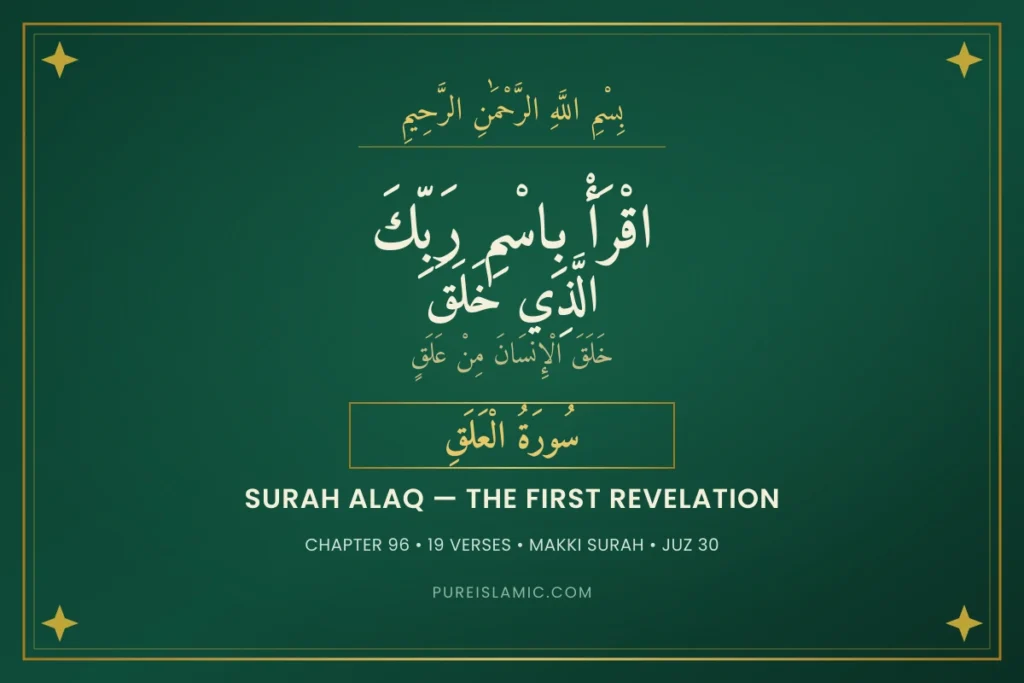
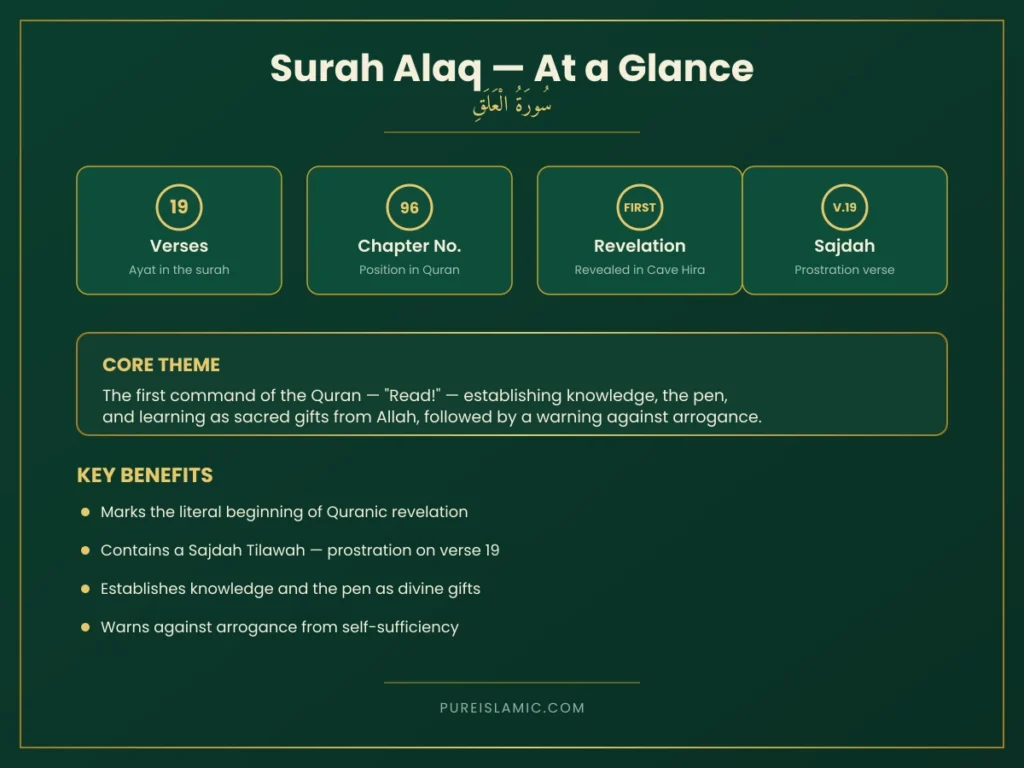
What is Surah Alaq about? Surah Alaq (سورة العلق), also written Surah Al-Alaq, is the 96th chapter of the Quran and contains 19 verses.
Its first five verses hold a unique distinction: they were the very first words of the Quran ever revealed, given to Prophet Muhammad ﷺ by Angel Jibril in the Cave of Hira. The surah opens with the command “Iqra” (“Read!”), establishing knowledge, reading, and the pen as gifts from Allah.
The remaining verses (6–19) were revealed later and address Abu Jahl, a Makkan chief who tried to stop the Prophet ﷺ from praying—making this surah a powerful combination of the birth of revelation and a warning against arrogance and oppression.
Quick Facts About Surah Alaq
| Detail | Information |
| Surah | Al-Alaq |
| Chapter Number | 96 |
| Verses | 19 |
| Words | 72 |
| Letters | 292 |
| Meaning | The Clot / The Clinging Substance |
| Revelation | Makki (Meccan) — first surah revealed |
| Juz | 30 (Amma Para) |
| Arabic Name | الْعَلَق |
| Also known as | Surah Iqra (“Read”) |
| Special note | Contains Ayat-e-Sajdah (verse 19)—a Sajdah of recitation |
What does Alak mean?
The word “alaq” (عَلَق) refers to the adhesive cap—the initial adhesive layer of the human embryo that is attached to the uterine wall. This is evident in verse 2, where Allah describes man’s evolution from this humble biological beginning, just before commanding him to study and specialize.
Classical commentators deliberately note the contrast: man, made of humble objects like shiny rags, advances without delay through the present with pen and knowledge (vv. 4–five). The name of the surah captures this arc—from biological beginnings to intellectual and worldly opportunities, all owed to Allah’s generosity.
For this reason, Surah Alaq is also commonly referred to as Surah Ikra, after its opening command, about which many students remember one great single word within the entire Quran—to train the Prophet ﷺ and all mankind to read, test, and seek knowledge in the name of Allah.
Surah Alaq Arabic Text (Full 19 Verses)
بِسْمِ اللَّهِ الرَّحْمَٰنِ الرَّحِيمِ
- اقْرَأْ بِاسْمِ رَبِّكَ الَّذِي خَلَقَ
- خَلَقَ الْإِنسَانَ مِنْ عَلَقٍ
- اقْرَأْ وَرَبُّكَ الْأَكْرَمُ
- الَّذِي عَلَّمَ بِالْقَلَمِ
- عَلَّمَ الْإِنسَانَ مَا لَمْ يَعْلَمْ
- كَلَّا إِنَّ الْإِنسَانَ لَيَطْغَىٰ
- أَن رَّآهُ اسْتَغْنَىٰ
- إِنَّ إِلَىٰ رَبِّكَ الرُّجْعَىٰ
- أَرَأَيْتَ الَّذِي يَنْهَىٰ
- عَبْدًا إِذَا صَلَّىٰ
- أَرَأَيْتَ إِن كَانَ عَلَى الْهُدَىٰ
- أَوْ أَمَرَ بِالتَّقْوَىٰ
- أَرَأَيْتَ إِن كَذَّبَ وَتَوَلَّىٰ
- أَلَمْ يَعْلَم بِأَنَّ اللَّهَ يَرَىٰ
- كَلَّا لَئِن لَّمْ يَنتَهِ لَنَسْفَعًا بِالنَّاصِيَةِ
- نَاصِيَةٍ كَاذِبَةٍ خَاطِئَةٍ
- فَلْيَدْعُ نَادِيَهُ
- سَنَدْعُ الزَّبَانِيَةَ
- كَلَّا لَا تُطِعْهُ وَاسْجُدْ وَاقْتَرِب ۩
(Verse 19 contains a Sajdah of recitation—prostration is recommended when this verse is read or heard.)
Surah Alaq Transliteration
Bismillahir Rahmanir Raheem
- Iqra’ bismi rabbika alladhi khalaq
- Khalaqa al-insana min ‘alaq
- Iqra’ wa rabbuka al-akram
- Alladhi ‘allama bil-qalam
- ‘Allama al-insana ma lam ya’lam
- Kalla inna al-insana layatgha
- Ar-ra’ahu staghna
- Inna ila rabbika ar-ruj’a
- Ara’ayta alladhi yanha
- ‘Abdan idha salla
- Ara’ayta in kana ‘alal-huda
- Aw amara bit-taqwa
- Ara’ayta in kadhdhaba wa tawalla
- Alam ya’lam bi-anna Allaha yara
- Kalla la’illam yantahi lanasfa’am bin-nasiyah
- Nasiyatin kadhibatin khati’ah
- Falyad’u n-Nadiyah
- Sanad’uz-zabaniyah
- Kalla la tuti’hu wasjud waqtarib
Surah Alaq English Translation
In the name of Allah, the Entirely Merciful, the Especially Merciful.
- Read in the name of your Lord who created —
- Created man from a clinging substance.
- Read, and your Lord is the most Generous —
- Who taught by the pen —
- Taught man that which he knew not.
- No! Indeed, man transgresses
- Because he sees himself self-sufficient.
- Indeed, to your Lord is the return.
- Have you seen the one who forbids
- A servant when he prays?
- Have you seen if he is upon guidance
- Or enjoins righteousness?
- Have you seen if he denies and turns away —
- Does he not know that Allah sees?
- No! If he does not desist, We will surely drag him by the forelock —
- A lying, sinning forelock.
- Then let him call his associates;
- We will call the angels of Hell.
- No! Do not obey him. But prostrate and draw near [to Allah].
Surah Alaq Urdu Translation (اردو ترجمہ)
بِسْمِ اللَّهِ الرَّحْمَٰنِ الرَّحِيمِ
- پڑھیے اپنے رب کے نام سے جس نے پیدا کیا،
- انسان کو جمے ہوئے خون کے لوتھڑے سے پیدا کیا،
- پڑھیے, اور آپ کا رب بڑا کریم ہے,
- جس نے قلم کے ذریعے سکھایا،
- انسان کو وہ سکھایا جو وہ نہیں جانتا تھا۔
- ہرگز نہیں! بے شک انسان سرکشی کرتا ہے،
- اس بنا پر کہ وہ اپنے آپ کو بے نیاز سمجھتا ہے۔
- بے شک آپ کے رب ہی کی طرف لوٹنا ہے۔
- کیا آپ نے اس شخص کو دیکھا جو منع کرتا ہے
- ایک بندے کو جب وہ نماز پڑھتا ہے؟
- بھلا بتائیے اگر وہ ہدایت پر ہو،
- یا تقویٰ کا حکم دے،
- بھلا بتائیے اگر اس نے جھٹلایا اور منہ پھیرا،
- کیا وہ نہیں جانتا کہ اللہ دیکھ رہا ہے؟
- ہرگز نہیں! اگر وہ باز نہ آیا تو ہم اسے پیشانی کے بالوں سے پکڑ کر گھسیٹیں گے،
- جھوٹی، خطاکار پیشانی کو۔
- پس وہ اپنی مجلس کو بلا لے،
- ہم بھی عذاب کے فرشتوں کو بلا لیں گے۔
- هرگز نہیں! آپ اس کی بات نہ مانیں، اور سجدہ کریں اور قریب ہو جائیں۔
Surah Al-Tafseer and explanation (verse by verse)
Verses 1–2: The first words of Revelation.
The opening verses of Surah Al-Ala mark the beginning of prophethood. According to the authentic stories recorded through Imam Bukhari, the angel Gabriel caught sight of the Prophet ﷺ inside the cave of Hira and asked him to “Read!”
Unable to read, the Prophet ﷺ said, “I do not read. Jibril embraced him firmly three times, each time resorting to repeating the message until he finally revealed these founding verses.
Verse 2 immediately grounds this command in humility—the guy is reminded that he is only formed by a shiny lump, no longer by any inherent greatness of his own.
Verses 3–5: Knowledge as a Divine Gift
“Read, your Lord is most generous—He who taught with a pen – taught man what he did not know.”
These verses establish three fundamental truths: Allah is extremely generous, the pen (writing and recorded information) is a divine gift, and in the long run, all human expertise is strapped back to Allah’s education. Let the scholars be aware that that is why Islam places such a high value on literacy, expertise, and the maintenance of information through writing.
Verses 6–8: The danger of self-sufficiency
“No! Surely man transcends the fact that he sees enough in himself. Surely you have a return to the Lord.”
Positioning understanding as a gift, the sura turns to prudence: when a man forgets the source of his blessings, he becomes arrogant and transgressive. Commentators, including Ibn Kathir, link this directly to Abu Jahl, whose wealth and status made him feel that he owed nothing to everyone—also, Allah Verse VIII ends this section with a solemn reminder that everyone will return to Allah for a long inheritance.
Verses 9–14: He who forbids prayer.
This passage was invented about Abu Jahl, who physically threatened the Prophet ﷺ by praying at the Kaaba. Al-Bukhari recorded that Abu Jahl vowed to step on the Prophet’s neck if he saw him praying there—a risk that Allah addresses immediately in these verses.
The rhetorical questions in verses 9–thirteen reveal the absurdity and injustice of forbidding the prayer of Allah’s servant, especially when that servant is on a good path and preaching righteousness. Verse 14 subtly asks, “Does any such person no longer understand that Allah sees everything?”
Verses 15–18: A stern warning
“No! If he doesn’t stop now, we’ll surely drag him through the front—a false, sinful front.”
Allah warns that persistent arrogance and obstruction carry even greater effects—vividly defined as catching the offender by the frontal rhythm, a powerful image of humiliation and helplessness Verses 17–18 suggest that Abu Jahl names his allies for help; Allah will mention punishment commands (zabniyah) in response.
Verse 19: The command to bow.
“No! Do not obey him now. But supplicate and approach [Allah].”
The surah ends by using a reminder to the Prophet ﷺ—and every believer—not to mail to a person who is now forbidden to worship, but to draw upon Allah through prayer as an alternative. This verse includes a prayer of recitation (prostration tilavah); that is, it is for Muslims to perform physical prayer while reading or listening.
The Virtue of Surah Alaq
Surah Alaq has a truly tremendous peculiarity in using the first revelation—it marks the literal beginning of the Quran and the beginning of the enterprise of Prophet Muhammad ﷺ. Scholars observe several additional factors that have distinctive features:
This is definitely one of the best handful of suras containing Sajdatilawah (verse 19), meaning its recitation or hearing offers bodily supplications as an act of humility before Allah.
The emphasis on iqra (“read”) is widely known as a motivation for Islam’s strong encouragement in literacy, education, and the pursuit of expertise.
At the beginning of this revelation, the Prophet ﷺ shows his humanity and weakness—giving comfort to the believers that even the best trials begin with uncertainty before the reading follows.
Background — Why was Surah Alaq revealed?
The Prophet ﷺ had developed a retreat in the Cave of Hira for solitary worship and meditation, often for several nights at a time, before returning to his wife Khadijah (RA) to renew food.
Overwhelmed, the Prophet ﷺ rushed home and asked to be wrapped in a cloth. Khadijah (RA) took him to her cousin Warkah ibn Nawfal, a Christian disciple who knew the previous scriptures, who confirmed that he matched the descriptions of the previous prophets and assured him of the calling of the Prophet ﷺ .
The latter verses (6–19) were revealed one at a time, somewhat later, in response to Abu Jahl’s attempt to physically rescue the Prophet ﷺ from the Kaaba prayer—the story omits many online surah pages altogether.
Contact with the Surahs before and after
Surah Alaq sits between Surah At-Tin (95) and Surah Al-Qadr (97) and covers its placement and meaning.
Surah At-Tin (95) ends with the affirmation of Allah as the simplest of judges. Surah Alak (96) now follows the real beginning of revelation and action—a concrete answer to how man is involved in discerning what is right and what is wrong: through revealed knowledge, beginning with commands of trial. Surah al-Qadr (97) then describes the night of the announcement, the night when this same revelation began—some scholars believe that Surah al-Qadr describes the night on which the first verses of Surah Al-Alaq were revealed.
Read together, these 3 Surahs go from divine judgment (At-Tin) to the beginning of discovered guidance (Al-Alaq) to the Supreme Night, whose control first descended (Al-Qadr).
Surah Alaq vs Surah Al-Qalam: What’s the Difference?
| Surah Alaq (96) | Surah Al-Qalam (68) | |
| Focus | The very first revelation—command to read | Defense of the Prophet ﷺ against accusations of madness |
| Verses | 19 | 52 |
| Core theme | Knowledge, the pen, and human origin | Character, patience, and vindication of the Prophet ﷺ |
| Shared element | Both surahs highlight “the pen” (al-qalam) as a symbol of knowledge and revelation |
Main Themes of Surah Alaq
Knowledge is a divine present—analysis, writing, and teaching all stem from the generosity of Allah, not my own human fulfillment.
Humble origins, expanded intelligence—man is created from an insignificant shiny lump and yet endowed with the capacity for information and control.
Arrogance follows forgetfulness—self-sufficiency without gratitude to Allah leads to transgression.
Worship must not be hindered—the Sura fiercely defends the righteousness of hope in opposition to individuals who seek to thwart it.
Closeness to Allah through humility—The surah ends with commands to bow down, the ultimate physical expression of submission.
Lessons From Surah Alaq
Seek knowledge in the form of worship. The first real commandment of the Quran is to read—practice and study give Islam a deep spiritual weight.
Remember your supplies. Success and wealth can lead to arrogance if gratitude to Allah is forgotten.
Stay organized when worship is interrupted. The Suran models an immediate, unwavering response to people who try to disrupt prayer.
Bow down while reciting verse 19 after the Sunnah of Sajdah Tilawah.
Exams are usually done before studying. The uncertainty of the beginning of the prophet’s revelation, along with assurance, gives comfort in difficult beginnings.
Related Articles on PureIslamic.com
- Surah Kafiroon: Arabic, Translation, Tafsir & Lessons
- How to Pray Namaz: A Complete Step-by-Step Guide
- How to Perform Wudu (Complete Guide)
- 10 Important Daily Duas Every Muslim Should Know
- Dua After Salah: Complete Adhkar Guide
Sources & References
- The Holy Quran, Surah Al-Alaq 96:1–19 — Quran.com
- Tafsir Ibn Kathir, Surah Al-Alaq — Quran.com
- Tafsir Ibn Kathir, full commentary on Surah Al-Alaq—honeyfortheheart.wordpress.com
- Tafsir Ibn Kathir, Surah Al-Alaq — Alim.org
- Sahih al-Bukhari narration on the first revelation and Abu Jahl incident, cited via Quran.com Ibn Kathir tafsir
- Surah At-Tin 95:1–8 and Surah Al-Qadr 97:1–5 (Quran.com) — for surah placement and connection
Written by: Abdul Wahab Reviewed by: [Hafiz Muneer Afridi] Last reviewed: August 23, 2026
Disclaimer: This article is intended for general knowledge and educational purposes only. Readers are encouraged to consult a qualified scholar for in-depth religious rulings or personal guidance.