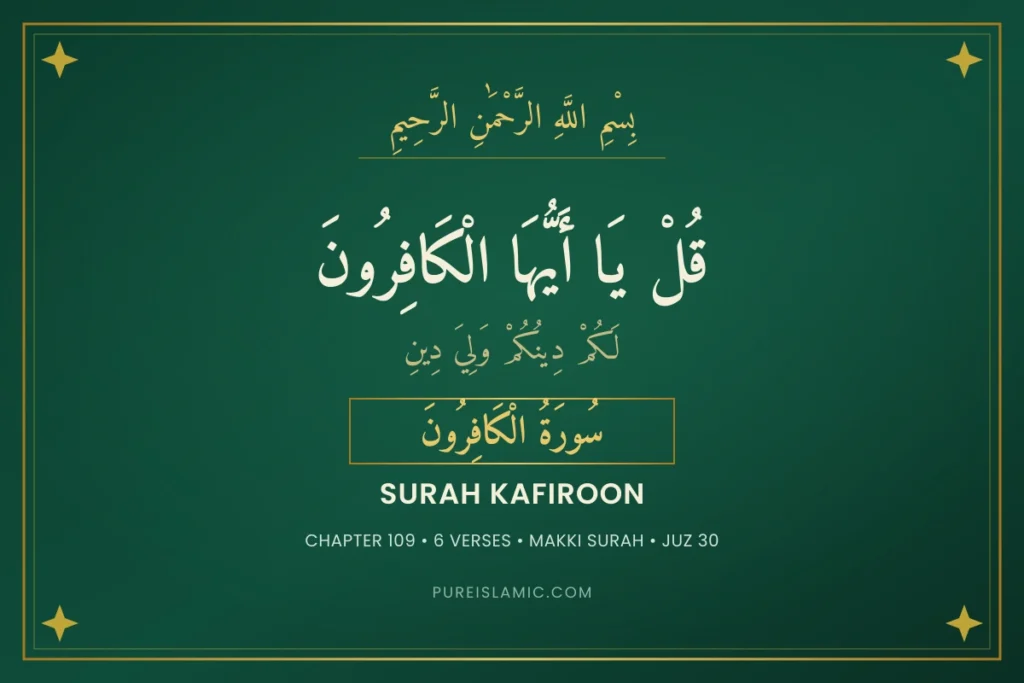
What is Surah Kafiroon about? Surah Kafiroon (سورة الكافرون), also written Surah Al-Kafirun, is the 109th chapter of the Quran, containing 6 verses. It was revealed in Makkah as Allah’s direct command to the Prophet ﷺ to reject a compromise offer from the Quraysh—who proposed that he worship their idols for a period in exchange for them worshipping Allah in return. The surah delivers one of the Quran’s clearest declarations of tawhid (monotheism), closing with the timeless line: “To you be your religion, and to me my religion.” Though only six verses long, Surah Kafiroon is considered equal to a quarter of the Quran in reward and is recited daily by millions of Muslims in Sunnah prayers.
Quick Facts About Surah Kafiroon
| Detail | Information |
| Surah | Al-Kafirun |
| Chapter Number | 109 |
| Verses | 6 |
| Words | 27 |
| Letters | 98 |
| Meaning | The Disbelievers |
| Revelation | Makki (Meccan) |
| Juz | 30 (Amma Para) |
| Arabic Name | الْكَافِرُونَ |
| Also known as | Surah of Worship, Surah of Sincerity (with Al-Ikhlas: “Al-Ikhlasayn”) |
What does “kafiroon” mean?
The word “Kafiroon” (الْكَافِرُونَ) is the plural of “kafir”—one who denies or conceals the truth of Allah’s oneness. In this surah, the address is not to the chosen disbelievers for all time, however, specifically to a limited group of Quraysh chiefs in Makkah who had approached the Prophet ﷺ with a proposal to merge Islam and idolatry into a common tradition.
Most commentators—including those cited in Tafsir Ibn Kathir and Tafsir Mariful Qur’an—agree that the surah’s language is intentionally absolute: it uses both a gift and future sharpening action to close every door to compromise, now and completely. Therefore, the name of the Sura names not only a group of people but also a role—the attitude of refusing to worship anything other than Allah, under any opportunity or inducement.
Surah Kafiroon Arabic Text (Full 6 Verses)
بِسْمِ اللَّهِ الرَّحْمَٰنِ الرَّحِيمِ
- قُلْ يَا أَيُّهَا الْكَافِرُونَ
- لَا أَعْبُدُ مَا تَعْبُدُونَ
- وَلَا أَنتُمْ عَابِدُونَ مَا أَعْبُدُ
- وَلَا أَنَا عَابِدٌ مَّا عَبَدتُّمْ
- وَلَا أَنتُمْ عَابِدُونَ مَا أَعْبُدُ
- لَكُمْ دِينُكُمْ وَلِيَ دِينِ
Surah Kafiroon Transliteration
Bismillahir Rahmanir Raheem
- Qul yā ayyuhal-kāfirūn
- Lā a’budu mā ta’budūn
- Wa lā antum ‘ābidūna mā a’bud
- Wa lā ana ‘ābidum-mā ‘abattum
- Wa lā antum ‘ābidūna mā a’bud
- Lakum dīnukum wa liya dīn
Surah Kafiroon English Translation
In the name of Allah, the Entirely Merciful, the Especially Merciful.
- Say: “O disbelievers!
- I do not worship what you worship.
- Nor are you worshippers of what I worship.
- And I will not be a worshipper of what you worship,
- Nor will you be worshippers of what I worship.
- You are your religion, and I am my religion.”
Surah Kafiroon Urdu Translation (اردو ترجمہ)
بِسْمِ اللَّهِ الرَّحْمَٰنِ الرَّحِيمِ
- فرما دیجئے: اے کافرو!
- میں ان کی عبادت نہیں کرتا جن کی تم عبادت کرتے ہو،
- اور نہ تم اس کی عبادت کرنے والے ہو جس کی میں عبادت کرتا ہوں،
- اور نہ میں ان کی عبادت کرنے والا ہوں جن کی تم نے عبادت کی،
- اور نہ تم اس کی عبادت کرنے والے ہو جس کی میں عبادت کرتا ہوں،
- تمہارے لیے تمہارا دین ہے اور میرے لیے میرا دین۔
Surah Kafiroon Tafsir & Explanation (Verse by Verse)
Verse 1: Qul — the actual command
Sarah Kafirun Kulti Shabden Arbhyate — “Kathayatu” iti. This is not always a suggestion but immediately a divine command, teaching the Prophet ﷺ to face the Quraysh publicly and unequivocally. Several suras within the Qur’an begin with “Qul” itself when a company, unmistakable declaration is required—and this is one of the clearest examples of that pattern
Verses 2–3: Present separation announcement
I do not worship what you worship, nor do you worship what you worship.
These verses confirm that the objects of worship themselves are essentially unique. The Quraysh worshiped their carved stone idols; the Prophet ﷺ worshiped Allah on his own, without our partner or image. Verse 3 adds a second layer—although the Quraysh claimed to also “worship Allah” with their idols, their way and information of worship was so corrupted by shirk that it could not be equated with natural monotheism
Verses four–five: Repetition for the sake of permanence, not for excess.
At first glance, verses 4–five seem to copy verses 2–3. Classical commentators explain that this repetition is planned and functional: verses 2–3 deny the prevailing occasion for shared worship, while verses 4–5 deny it as well for luck—and lastly, any desire that the Prophet ﷺ would likely comply with the agreement sooner or later. Ibn Kathir notes that this grammatical shift from gift to destiny removes any ambiguity about the permanence of this strained distinction.
Verse 6: Lakum Dinukum Wa Liya Din — Last Word
Bhvah Bhvatu, Mahah Bhva Mam Krite.
This remaining verse is routinely misunderstood today as the preferred name for religious pluralism or tolerance of all beliefs, which is likewise legitimate by commentators among whom Sayyid Abul Ala Maududi clearlyInterestingly, jurists including Imam Abu Hanifa and Imam Shafi’i drew a separate legal principle from this verse: that people of different disbelief systems can be treated as one category for certain rulings (such as inheritance among non-Muslims of different faiths), since the verse groups “your religion” as a single opposing category to “my religion.”
The Virtue of Reciting Surah Kafiroon
Surah Kafiroon contains some of the strongest documented features of any condensed Surah in the Quran:
The Prophet ﷺ said that Surah Al-Kafirun is equal to 1/4 of the Quran in praise.
When the partners begged for prayer to be recited before they fell asleep, the Prophet ﷺ taught them Surah Kafiroon and said that it would immunize them from shirk (idolatry)—a statement transmitted by Tirmidhi and Abu Dawud.
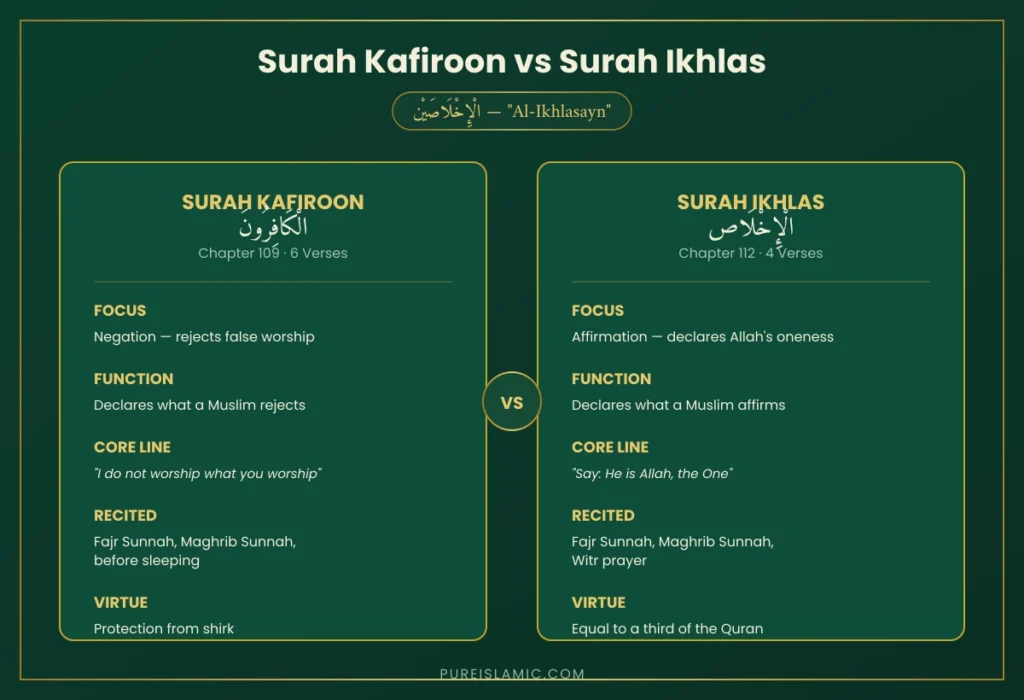
It became a regular practice for the Prophet ﷺ to recite Surah Kafiroon along with Surah Ikhlas in the two sunnah rak’at before Fajr and after Maghrib.
Because of this pairing, Surah Kafiroon and Surah Ikhlas are collectively called al-Ikhlasayn”—”the two suras of unity”—because one enunciates what is denied and the other enunciates what it affirms.
As always, these supposed virtues are inseparable from mastering reality and dwelling in the Sura’s message of undivided devotion to Allah.
Surah Kafiroon Benefits in Urdu (اردو میں فضیلت)
سورۃ الکافرون کی فضیلت احادیث میں یوں بیان ہوئی ہے:
- نبی کریم ﷺ نے فرمایا کہ سورۃ الکافرون قرآن کے ایک چوتھائی حصے کے برابر ہے۔
- سونے سے پہلے اس سورت کی تلاوت شرک سے حفاظت کا ذریعہ ہے — یہ ترمذی اور ابو داؤد کی روایات میں مذکور ہے۔
- نبی کریم ﷺ فجر کی سنتوں اور مغرب کے بعد کی سنتوں میں سورۃ الکافرون اور سورۃ الاخلاص دونوں کی تلاوت فرمایا کرتے تھے۔
Background — Why was Surah Kafiroon revealed?
According to Ibn Abbas (may Allah be pleased with him) and various early narrators, several Quraysh leaders—such as Walid bin Mugirah, As bin Wail, Aswad bin al-Muttalib, and Umayyah bin Khalaf—made a suggestion to the Prophet ﷺ that if he could pray to Allah alone, he could pray to Allah. for 12. In some other version of the story, they offered him money and marriage into their tribe if he would stop criticizing their gods frequently.
Surah Kafiroon was found to be Allah’s unequivocal answer that there is no model for this system that can be given to Islam. This is a critical piece of background missing from most surah pages on the line—without it, verse 6 is easily misinterpreted as a trendy declaration of spiritual tolerance rather than what it really is: a communal boundary drawn across the medium of worship itself.
Connection With the Surahs Before and After
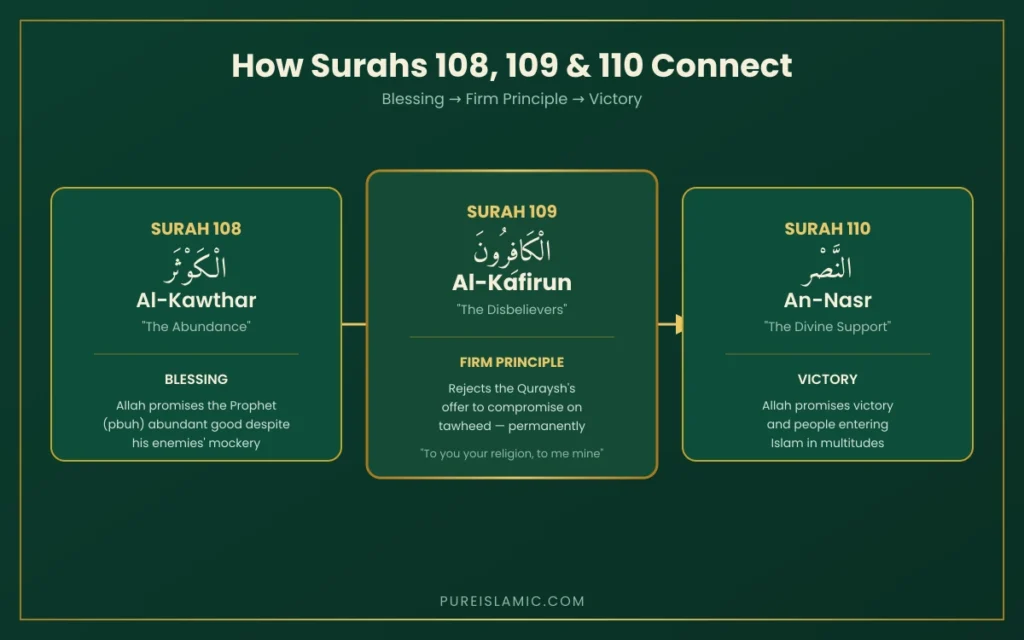
Sura Kafiroon sits between Sura Al-Kawthar (108) and Sura An-Nasr (100), and the placement is known to us.
Surah Al-Kawthar (108) assures the Prophet ﷺ of many blessings despite ridicule and isolation from his enemies. Surah Kafiroon (109) now follows by showing what that blessing imposes and demands—an unwavering position for Tawheed even when the region around it gives money and change to dilute it. Surah An-Nasr (One Hundred and Ten) then completes the arc: After this body refuses to compromise, Allah ensures victory and mass passage of human beings in Islam.
Read together, these 3 surahs form a quick but complete story: blessing (al-kawthar) → firm advice no matter the stress (al-kafirun) → ultimate victory (an-nasr).
Surah Kafiroon vs. Surah Ikhlas: What’s the Difference?
| Surah Kafiroon (109) | Surah Ikhlas (112) | |
| Focus | Rejects false worship (negation) | Affirms Allah’s oneness (affirmation) |
| Verses | 6 | 4 |
| Core theme | “I don’t worship what you worship.” | “Say: He is Allah, the One.” |
| Function | Declares what a Muslim rejects | Declares what a Muslim affirms |
| Together known as | Al-Ikhlasayn — the two surahs of sincerity |
Main Themes of Surah Kafiroon
Tawheed is nonnegotiable—no amount of encouragement, social pressure, or compromise can undermine my own natural worship of Allah.
Worship cannot be mixed—Islam and shirk are essentially distinct categories that cannot be merged into a common practice.
Permanent, not brief, separation — repeated verses close to some future agreement, now not just the present.
Clarity over vague tolerance—Verse 6 is a statement of limitations, not an endorsement of irreligious relativism.
Strong principle precedes victory—its placement between al-Qawthar and an-Nasr indicates steadfastness as a path to ultimate success.
Lessons From Surah Kafiroon
Know where your barriers are. Surah Kafiroon describes a way to firmly reject compromise on moderate matters of religion without hostility.
Clarity protects you from later attenuation. Small compromises in theory often do not leave small—this surah closes the door early and absolutely.
Follow your own guidance of the Prophet ﷺ and read it before you go to sleep as a way to safety.
Pair it with Surah Ikhlas in your daily Sunnah prayers to combine the denial of the lie with the affirmation of the facts.
“Yours is your religion, mine is mine” is set worship, no longer indifference—Muslims are still commanded elsewhere within the Qur’an to treat men of other religions fairly and kindly in worldly affairs.
Frequently Asked Questions About Surah Kafiroon
What is Surah Kafiroon about? Surah Kafiroon (Chapter 109) is Allah’s command to the Prophet ﷺ to reject a Quraysh offer to compromise on worship. In 6 verses, it declares complete and permanent separation between the worship of Allah and the worship of idols.
How many verses does Surah Kafiroon have? Surah Kafiroon has 6 verses and 27 words, making it one of the shortest surahs in the Quran, located in Juz 30.
Is Surah Kafiroon Makki or Madani? Surah Kafiroon is a Makki surah, revealed in Makkah before the Prophet’s ﷺ migration to Madinah.
Why was Surah Kafiroon revealed? It was revealed after Quraysh leaders offered to worship Allah for a year if the Prophet ﷺ would worship their idols for a year in return — an offer this surah firmly and permanently rejects.
What does “to you be your religion, and to me my religion” mean? It is a declaration of complete separation in worship, not a statement that all religions are equally valid. Classical tafsir clarifies it exonerates Muslims from the disbelievers’ rites, not that Islam endorses religious relativism.
What are the benefits of reciting Surah Kafiroon? The Prophet ﷺ described it as equal to a quarter of the Quran and taught his companions to recite it before sleeping for protection from shirk. It is also regularly recited in the Sunnah prayers before Fajr and after Maghrib.
Why is Surah Kafiroon recited with Surah Ikhlas? Together they are called Al-Ikhlasayn — Surah Kafiroon rejects false worship while Surah Ikhlas affirms Allah’s oneness, forming a complete statement of sincere devotion. The Prophet ﷺ regularly recited both in the same Sunnah prayers.
What is the connection between Surah Al-Kawthar, Surah Kafiroon, and Surah An-Nasr? Surah Al-Kawthar promises the Prophet ﷺ abundant blessing despite opposition, Surah Kafiroon shows the firm principle that blessing requires — refusing compromise on tawheed — and Surah An-Nasr promises the victory that follows that steadfastness.
Can Surah Kafiroon be recited in daily prayers? Yes — it is commonly recited in the Sunnah rak’ahs before Fajr, after Maghrib, and often in Witr prayer.
Who was Surah Kafiroon revealed about? Scholars mention Quraysh leaders including Walid bin Mughirah, As bin Wa’il, Aswad bin Al-Muttalib, and Umayyah bin Khalaf. However, the surah’s message applies universally to any offer to compromise on tawheed, not only to these specific individuals.
What are the benefits of Surah Kafiroon in Urdu? سورۃ الکافرون کی تلاوت قرآن کے ایک چوتھائی حصے کے برابر اجر رکھتی ہے، سونے سے پہلے پڑھنے سے شرک سے حفاظت ملتی ہے، اور یہ فجر و مغرب کی سنتوں میں پڑھی جاتی ہے۔
Related Articles on PureIslamic.com
- How to Pray Namaz: A Complete Step-by-Step Guide
- How to Perform Wudu (Complete Guide)
- 10 Important Daily Duas Every Muslim Should Know
- Subha Sham Azkar: Complete Morning & Evening Guide
- Dua After Salah: Complete Adhkar Guide
Sources & References
- The Holy Quran, Surah Al-Kafirun 109:1–6 — Quran.com
- Tafsir Ibn Kathir, Surah Al-Kafirun — Quran.com
- Tafsir Maariful Quran, Surah Al-Kafirun — Quran.com
- Tafsir Maariful Quran, full commentary — IslamicStudies.info
- Surah Al-Kafirun: Translation & Transliteration, virtue in Fajr Sunnah (Sunan Ibn Majah 1148) — MyIslam.org
- Surah Al-Kafirun—Islamic Center, virtue of “immunity from shirk” (Abu Ya’la, Tabarani) and “quarter of the Quran” narration
- Surah Ikhlas — connection with Surah Kafiroon, Sahih Muslim narration — MyIslam.org
- Surah Al-Kawthar 108:1–3 and Surah An-Nasr 110:1–3 (Quran.com)—for surah placement and connection
Written by: Abdul Wahab Reviewed by: [[Hafiz Muneer Afridi] Last reviewed: August 20, 2026
Disclaimer: This article is intended for general knowledge and educational purposes only. Readers are encouraged to consult a qualified scholar for in-depth religious rulings or personal guidance.