What is Surah Maun about? Surah Maun is the 107th chapter of the Quran, containing 7 verses. It opens with a piercing question—”Have you seen the one who denies the Final Judgment?”—and then reveals what that denial actually looks like in real life: harshly turning away an orphan, failing to encourage the feeding of the poor, neglecting prayer through carelessness and showing off, and refusing to give even the smallest act of neighborly help. Surah Maun is a mirror held up to society—it shows that genuine faith in Allah and the Hereafter cannot coexist with cruelty toward the vulnerable, hollow prayer, or self-centered living.
Quick Facts About Surah Maun
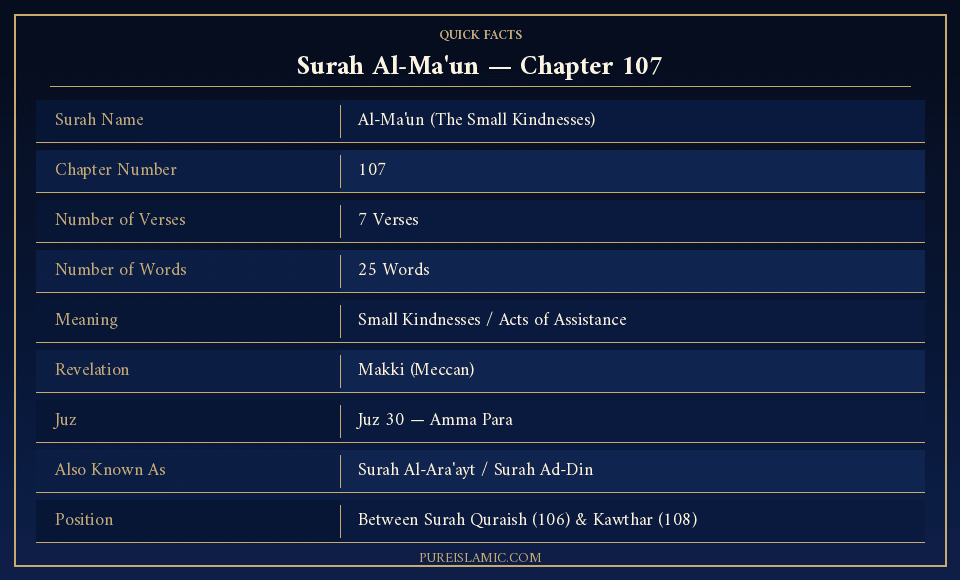
| Detail | Information |
|---|---|
| Surah | Al-Ma’un |
| Chapter Number | 107 |
| Verses | 7 |
| Meaning | Small Kindnesses / Neighbourly Needs / Almsgiving |
| Revelation | Makki (Meccan) |
| Juz | 30 (Amma Para) |
| Arabic Name | الماعون |
| Also known as | Surah Al-Ara’ayt / Surah Ad-Din |
| Comes after | Surah Quraish (106) |
What Does Maun Mean?
The word “maun” (الْمَاعُون) is one of the most frequently mentioned words in Quranic scholarship.
First View—Zakat: Ali (R.A.), Ibn Umar (R.A.), Sa’eed Ibn Zubair, Qatadah and Hasan Basri believe that Maun refers to Zakat—the obligatory annual charity
Second Opinion—Little Ordinary Mercy: Ibn Abbas (RA), Ibn Masood (RA), Mujahid and Ikrima believe that “Maun” refers to objects of ordinary use every day—kitchen pot, buckets, water, salt—which are small things borrowed by neighbors from each other
United Views: Imam Ali (R.A.) believed that Ma’un includes every Zakat and small simple courtesy. Ibn Abi Hatim says from Ikrimah, “Maun of the highest form is Zakat; maun of lower size borrows a sieve, a bucket, or a needle.”
The message of the surah is equally active during the reading or… Illness and hardness of heart are diseases, not scales.
Surah Maun Arabic Text (Full 7 Verses)
بِسْمِ اللَّهِ الرَّحْمَٰنِ الرَّحِيمِ
- أَرَأَيْتَ الَّذِي يُكَذِّبُ بِالدِّينِ
- فَذَٰلِكَ الَّذِي يَدُعُّ الْيَتِيمَ
- وَلَا يَحُضُّ عَلَىٰ طَعَامِ الْمِسْكِينِ
- فَوَيْلٌ لِّلْمُصَلِّينَ
- الَّذِينَ هُمْ عَن صَلَاتِهِمْ سَاهُونَ
- الَّذِينَ هُمْ يُرَاءُونَ
- وَيَمْنَعُونَ الْمَاعُونَ
Surah Maun Transliteration
Bismillahir Rahmanir Raheem
- Ara’aytal-ladhi yukadhdhibu bid-din
- Fa-dhaalikal-ladhi yadu’ul-yatim
- Wa la yahuddu ‘ala ta’amil-miskin
- Fa-waylul-lil-musallin
- Alladhina hum ‘an salatihim sahun
- Alladhina hum yura’un
- Wa yamna’unal-ma’un
Surah Maun English Translation
In the name of Allah, the Entirely Merciful, the Especially Merciful.
- Have you seen the one who denies the Day of Recompense?
- That is the one who drives away the orphan.
- and does not encourage the feeding of the poor.
- So woe to those who pray —
- those who are heedless of their prayers,
- those who only show off,
- and withhold small acts of assistance.
Surah Maun Tafseer and Explanation (Verse by Verse)
Verse 1: The piercing question — did you see it?
Surah Silence begins with one of the most frequent questions in the entire Quran: “Ara’yta”—”What have you seen?” This is hardly a physical sight. An invitation to meet with caution and to imagine deeply what kind of person might reject a day of vengeance.
The word “ad-Din” right here is mostly the day of judgment and the way to divine accountability. Some scholars note that it additionally contains connotations of divine law and justice—so the verse can be studied thus: “Have you seen the one who denies the very principle of a just social order?”
Both readings reinforce each other: there is no motivation to remain in this world without applying the concept to character and otherworldly commitment.
Verses 2–3: Two Attributes of the Rejected Akhirah
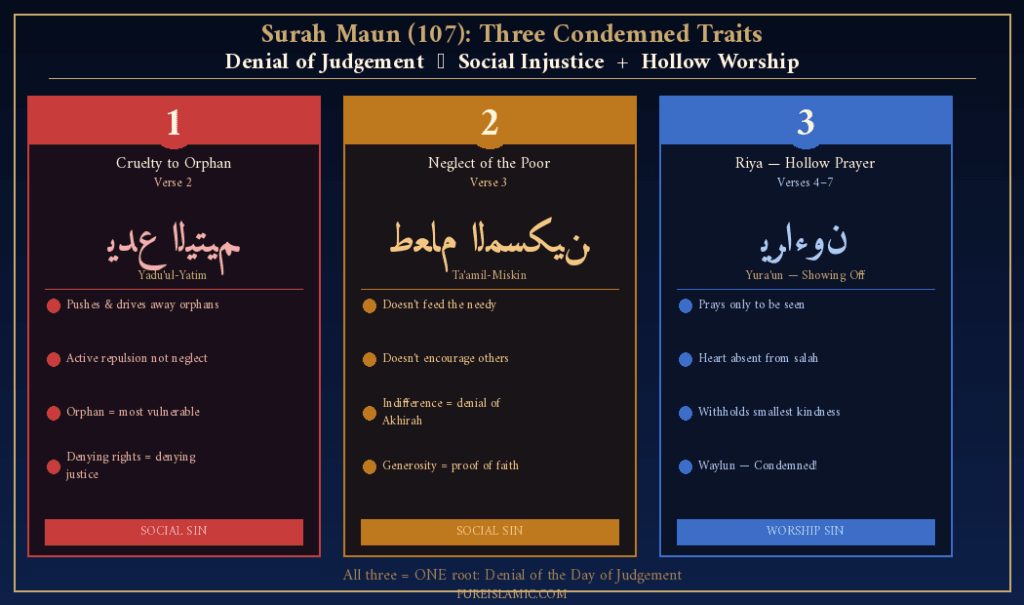
Surah Silence informs us without delay what it looks like to deny the afterlife—not through theology, but still through practice.
They forcibly remove the widow (yadu’ul-yati): the word “yadu’u” is actually more powerful than “neglect.” The way to push, push, or pull back. This person actively alienates widows.
They no longer encourage feeding the negative: Note the appropriate words. They no longer encourage others to feed the negatives, let alone the awful ones.
Both of these behaviors are the natural consequences of a lack of commitment. If there is no judgment day, why sacrifice comfort to strangers?
Verse 4: Waylun—Woe unto them that pray.
Here Surah Silence provides his most unexpected change. Verse 4 begins, “Fa-waylun lil-musallin”—”So woe to the people who pray.”
Waylun is one of the strongest expressions of blasphemy against the Quran. And it’s miles away, and not to pagans or unbelievers—to people who pray anyway.
This is the most powerful emphasis of Surah Maun: an external spiritual practice without sincerity.
Verse 5: Their neglect of prayer (sahun)
Surah Maun specifies exactly which prayers are condemned—individuals who are sahun (careless and irrational). This includes, among other things:
The most manual prayer due to others watching
The delay of prayers to their time is due to indifference, generally.
to go through the motions of the heart completely absent
The Prophet ﷺ described the prayer of the hypocrite: “He sits and looks at the sun until it is miles between the 2 horns of Satan. Then he stands and fucks 4 rak’ahs quickly, with little or no remembrance of Allah in them. (Sahih al-Bukhari, Sahih Muslim)
Verse 6: Rhea—destroyer of secrets.
“Those who perform practically.” The phrase “yura’un” in Arabic comes from “riya”—worshiping visibly and boastfully through humans instead of for Allah.
The Prophet ﷺ’s riya is known as “minor polytheism”—associating the opinions of others with the worship of Allah Himself. Surah Maun juxtaposes riya with cruelty to orphans and withholding charity—all symptoms of the same basic disease: disconnection from real commitment to Allah.
Verse 7: Al-Ma’un talming
Surah Maun ends with the decisive act of this damned person that they withhold maun—be it zakat, borrowed pot, or any small and ordinary help to others.
As the Prophet ﷺ said, “Every peak is a gift.” Indeed, many are accurate enough to meet your brother’s smile on your face and pour what’s left in the bucket into your brother’s dish. (Jami’ al-Tirmidhi 1970)
The one condemned in Surah Maun cannot even attempt this. Their prayer to show their heart absent and their hand closed.
The Virtue of Reciting Surah Maun
A tradition reported by Imam Baqir (a.s.) says, “Whoever recites Surah Maun in his obligatory and optional prayers, Allah accepts his prayer and his fast, regardless of the evil he has done in this realm of the world. (Majma’ al-Bayn, vol. 10).
As in all such narratives, religious preference is inseparable from truly mastering and implementing the message of Surah Moon.
Who Was Surah Maun Revealed About?
Scholars point out that several Quraish leaders were viable subjects:
mentioned with the help of al-‘as ibn W’il al-Sahmi—Muqatil and al-Kalbi
Abu Sufyan Ibn Harb—named through Ibn Jurayj
Walid ibn al-Mughirah and others recognized the combination of enormous wealth with social cruelty.
But the collective gift of Surah Maun is strained, and the use of kulli makes it clear that it is a warning to everyone at all times—not just certain historical figures.
The Powerful Connection: Sura Quraish and Sura Silence
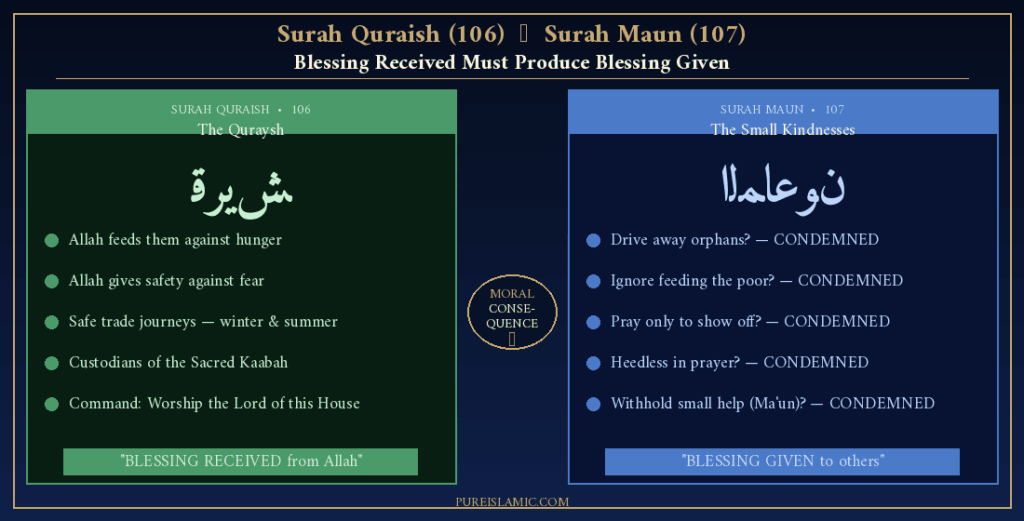
Suran Maun (107) follows immediately after Suran Quraish (106)—and this placement is theologically intentional.
Surah Quraish tells us, “Allah has fed you in resistance to hunger and made you safe from worry—so worship the Lord in this house.”
Surah Maun immediately replies that if Allah has fed you, feeding others is a proof of your gratitude. It is the pinnacle of ingratitude to seek the provision of Allah and then put pressure on the orphans, care for the hungry, and withhold small favors.
Together, the surahs form a unified moral argument that a blessing received from Allah should lead to a blessing given to others.
Two Wings of a Complete Muslim Life
Surah Silence identifies the crucial dimensions of genuine religion:
Wing 1—Haq Allah (Rights of Allah): Prayer, worship, and ritual devotion.
Aspect 2—Haq al-Ibaad (Rights of the people): charity, justice, kindness to the orphans, and feeding the negative.
The warning of Surah Moon is clear: one page alone cannot blow you away. Prayer disconnected from social duties is not always just weak—it is far from condemned according to this Sura.
Surah Maun and Today — A Modern Mirror
There are direct parallels these days with the social conditions that Surah Maun addressed in Mecca in the 7th century. Despite the exploitation of widows by the powerful elites who controlled the Kaabah, negative existence exists in all societies and every technology.
Surah Maun obliges every Muslim to offer the following:
Is my prayer real worship or a social performance?
Am I actively ignoring the slopes around me?
Do I encourage others to help those in need, or do I live in silence?
Do I withhold small ordinary acts of kindness?
Main Themes of Surah Maun
Belief in accountability drives ethical behavior—denying the Day of Judgment leads to cruelty and indifference in this world.
Social obligation is inseparable from faith—orphans and heretics are direct tests of the concept of reality.
Hollow prayer is condemned; now it is not praised—Surah silently says “Waylun”—woe—in careless prayer.
Rhea (seeing) destroys worship—work completed before the eyes of people who prefer Allah’s pleasure becomes spiritually useless.
Small acts of kindness are remarkably reliable—here the doomed Ma’un is the least conceivable helper. His rejection indicates the well-known profoundly diseased coronary artery.
Lessons From Surah Maun
Notice the inspiration for your prayer. Before every salaah, ask, “Am I doing this for Allah or for men?”
Your faith is measured by your treatment of the weak. Orphans, wicked, unhappy neighbors—these are the real assessments of Surah Moon.
Even small auxiliary issues. Ma’un is not a millionaire in charity. Guilt, pot, smile, face, words of encouragement. To deny even those celebrities anything deeply wrong.
Rhea is risky because she is hidden. The person who did Riya also looked like the most pious person in the room. Surah Silence opens up the possibility of judging piety through forms.
The denial of justice leads to moral collapse. When people stop believing in accountability, they stop worrying about justice. Surah Maun shows that this produces real, identifiable behavior.
Frequently Asked Questions About Surah Maun
What is Surah Maun about? Surah Maun (Chapter 107) warns against a specific type of person: one who denies the Day of Judgement—and whose denial shows in how they treat orphans, the poor, their prayers, and even the smallest acts of kindness. It is a complete moral warning in 7 short verses.
What does Maun mean in the Quran? “Ma’un” means small kindnesses and acts of assistance—ranging from Zakat (according to some scholars) to small borrowed household items like a pot or bucket (according to others). Surah Maun condemns withholding both.
How many verses are in Surah Maun? Surah Maun contains 7 verses and 25 words, making it one of the short but powerful surahs of Juz 30.
Is Surah Maun Makki or Madani? Surah Maun is primarily a Makki surah. However, some scholars note that verses 4–7 about the heedless prayers may have Madani elements, since hypocrisy became more prominent in the Madinan period.
What does “woe to those who pray” mean in Surah Maun? This is one of the most striking moments in Surah Maun. The word “Waylun” (woe) is not directed at people who don’t pray—it is directed at those who pray heedlessly and only to be seen. Hollow, show-off prayer is not a virtue—Surah Maun condemns it.
What is riya, and why does Surah Maun warn against it? Riya is performing acts of worship to be seen and praised by people rather than for Allah. The Prophet ﷺ called it “the minor shirk.” Surah Maun lists it alongside cruelty to orphans and withholding charity as symptoms of the same root disease.
What is the connection between Surah Quraish and Surah Maun? Surah Quraish (106) describes how Allah fed the Quraysh and kept them safe. Surah Maun (107) follows as the moral consequence: if Allah has fed you, the proof of your gratitude is feeding others. To receive provision and then drive away orphans and withhold from the poor is hypocrisy.
Who was Surah Maun revealed about? Scholars mention Al-‘As ibn Wa’il, Abu Sufyan ibn Harb, and others. However, Surah Ma’un’s universal language makes it a warning for everyone—not just specific historical individuals.
What are the benefits of reciting Surah Maun? A narration from Imam Baqir (AS) states that whoever recites Surah Maun in obligatory and optional prayers will have their prayers and fasting accepted and their worldly misdeeds forgiven. The real benefit is understanding its message and letting it shape one’s character.
What does Surah Maun say about orphans? Surah Maun uses the word “yadu’u”—to push or drive away—describing how the denier of Judgement treats orphans. This is not passive neglect; it is active repulsion. Surah Maun places this at the very heart of moral failure.
Closing Supplication
O Allah, protect us from praying with heedless hearts and showing-off tongues.
O Allah, make us among those who honor the orphan, encourage the feeding of the poor, and give freely—even from what is small.
O Allah, accept our prayers, our fasting, and our charity—and do not let us be among those condemned by Surah Maun.
Ameen, O Lord of the Worlds.
Related Articles on PureIslamic.com
- How to Pray Namaz: A Complete Step-by-Step Guide
- How to Perform Wudu (Complete Guide)
- 10 Important Daily Duas Every Muslim Should Know
- Surah Quraish (106): Arabic, Translation, Tafsir & Lessons
- Surah Humazah (104): Arabic, Translation, Tafsir & Lessons
- Surah Al-Fajr (89): Arabic, Translation, Tafsir & Lessons
- Dua After Salah: Complete Adhkar Guide
Sources & References
- The Holy Quran, Surah Al-Ma’un, 107:1–7
- Tafsir Ibn Kathir (Surah 107)
- Tafsir Maariful Quran — Mufti Muhammad Shafi
- Tafhim al-Qur’an — Sayyid Abul Ala Maududi (Surah 107 footnotes)
- Majma’ al-Bayan, vol. 10 (virtue of recitation)
- Sahih al-Bukhari & Sahih Muslim (hypocrite’s prayer hadith)
- Jami’ at-Tirmidhi 1970 (every good is charity)
- Surah Quraish 106:1–4 (connection with Surah Maun)
Written by: Abdul Wahab Reviewed by: Hafiz Munir Ahmed Last reviewed: August 13, 2026
Disclaimer: This article is intended for general knowledge and educational purposes only. Readers are encouraged to consult a qualified scholar for in-depth religious rulings or personal guidance.