What is Surah Quraish about? Surah Quraish is the 106th chapter of the Quran, containing 4 verses. It reminds the Quraish tribe of two enormous blessings Allah gave them—the security to travel for trade in winter and summer and the safety and food they enjoyed because of the Kaabah. In return for these blessings, they are commanded to worship the Lord of the House alone. The surah’s deeper message applies to every Muslim: recognize Allah’s blessings in your life, and respond with gratitude and sincere worship.
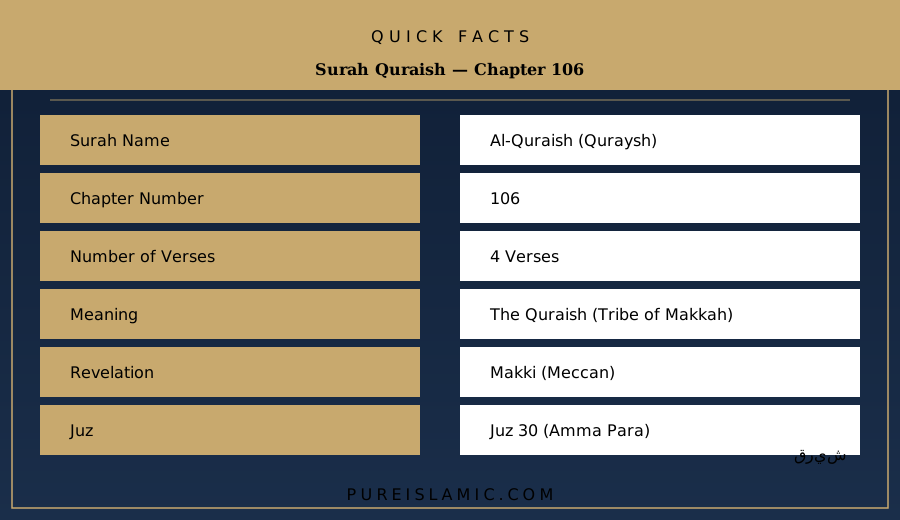
Quick Facts About Surah Quraish
| Detail | Information |
|---|---|
| Surah | Al-Quraish (Quraysh) |
| Chapter Number | 106 |
| Verses | 4 |
| Meaning | The Quraish (a tribe of Makkah) |
| Revelation | Makki (Meccan) |
| Juz | 30 |
| Arabic Name | قُرَيْش |
| Also known as | Surah al-Ilaf |
What does Quraish mean?
“Quraish” (قُرَيْش) refers to the Meccan tribe—the tribe of the Prophet Muhammad ﷺ—who were the guardians of the Kaabah. Sura takes his call directly from them. The Quraish were widely respected throughout Arabia because they were the Guardians of the Holy Shrine, which gave them a unique privilege: a surefire way to effect change throughout the Arabian Peninsula even in cases of tribal conflict.
The word “ilaf” (إِيلَاف), which appears in the established verse, means familiarity, a common feeling, or being aware of something—in this case, the custom is to link up on the Quraish’s annual business trips: one to Yemen in the winter and one to Syria in the summer.
Surah Quraish Arabic Text (Full 4 Verses)
بِسْمِ اللَّهِ الرَّحْمَٰنِ الرَّحِيمِ
- لِإِيلَافِ قُرَيْشٍ
- إِيلَافِهِمْ رِحْلَةَ الشِّتَاءِ وَالصَّيْفِ
- فَلْيَعْبُدُوا رَبَّ هَٰذَا الْبَيْتِ
- الَّذِي أَطْعَمَهُم مِّن جُوعٍ وَآمَنَهُم مِّنْ خَوْفٍ
Surah Quraish Arabic Text (Full 4 Verses#)
بِسْمِ اللَّهِ الرَّحْمَٰنِ الرَّحِيمِ
- لِإِيلَافِ قُرَيْشٍ
- إِيلَافِهِمْ رِحْلَةَ الشِّتَاءِ وَالصَّيْفِ
- فَلْيَعْبُدُوا رَبَّ هَٰذَا الْبَيْتِ
- الَّذِي أَطْعَمَهُم مِّن جُوعٍ وَآمَنَهُم مِّنْ خَوْفٍ
Surah Quraish English Translation
The call of Allah is absolutely to the merciful, especially the merciful.
For the usual security of Quraish—
The security to which they are accustomed on their journeys in the snow and in the summer —
Worship the Lord in this house.
who fed them against hunger and kept them safe from fear.
Surah Quraish Tafsir & Explanation
Verse 1–2: The Blessing of Safe Travel (Ilaf)
The surah opens with a reference to a remarkable privilege: the Quraish’s custom of two safe trade journeys each year—to Yemen in winter (for its warmer climate and trade routes to the Indian Ocean) and to Syria in summer (for its cooler weather and access to Mediterranean markets). These weren’t ordinary trips; at a time when the Arabian Peninsula was filled with tribal conflict and highway robbery, the Quraish alone could travel freely and safely.
Why? Because of their status as the keepers of the Kaabah. Other Arab tribes respected and feared harming the people associated with the sacred sanctuary. This privilege gave the Quraish both wealth and prestige.
A Note on the Arabic Grammar of “Ilaf”: Scholars of the Arabic language have discussed what the opening lam (ل) in Li-ilafi Quraish is connected to. One view (held by Akhfash, Kisa’i, and Farra) is that it is a lam ta’ajjub (lam of amazement)—meaning the verse is an expression of wonder at how Allah unified and secured the Quraish. Another view (held by Khalil ibn Ahmad, Sibawayh, and Zamakhshari) is that it is a lam ta’lil (lam of causation), meaning it links directly to the command in verse 3: “Because of the Quraish’s unification and safe journeys—therefore, let them worship the Lord of this House.” Both readings are linguistically valid, and both lead to the same essential message.
Scholars of tafsir such as Ibn Kathir note that this opening is directly connected to the preceding surah—Surah Al-Fil—which described how Allah destroyed the army of Abraha when it marched to demolish the Kaabah. That divine protection of the Kaabah is what maintained the Quraish’s status and their ability to travel safely. The implicit message: if Allah hadn’t protected the Kaabah (Surah Al-Fil), none of these blessings (Surah Quraish) would exist.
Verse 3: The Command to Worship
Having reminded the Quraish of this enormous blessing, Allah then gives a direct command: “So let them worship the Lord of this House.” This is the turning point of the surah — blessings must produce gratitude, and genuine gratitude is expressed through worship.
The phrase “Lord of this House” (Rabba ha’adhal-bayt) is significant. The Kaabah itself was the source of the Quraish’s special status, yet many of them were worshipping idols placed inside it. The command points them back to the One who actually gave them everything — not the idols, but the Lord who owns and controls the House itself.
A Warning Within the Blessing: Commentators point out that this verse also carries an implicit warning. Just as Allah destroyed Abraha and his mighty army for threatening the Kaabah, He was equally capable of destroying the Quraish themselves if they rejected worship and turned to arrogance. The same power that protected them could just as easily be turned against them. History bore this out—the Quraish initially became the most persistent enemies of the Prophet ﷺ when he began calling them to worship Allah alone, despite owing everything they had to the Kaabah and its Lord.
Verse 4: Food and Security — Two Foundational Blessings
The surah closes by specifying exactly what Allah provided: food against hunger and security against fear. Scholars point out these are the two most essential human needs—sustenance and safety. Without these, no civilization, trade, or worship is possible. The Quraish had both, and both came from Allah’s special arrangement around the Kaabah.
<cite index=”6-1″>Commentators note that the phrase “fed them against hunger” implies they were provided all year round with every kind of fruit and food—remarkable for a people living in the dry, arid valley of Makkah, a place with no agriculture of its own.
Surah Quraish and Surah Al-Fil: Why They’re Connected
The connection is theological: Surah Al-Fil describes Allah’s destruction of Abraha’s elephant army, which protected the Kaabah. Surah Quraish then explains the result—the Quraish were able to enjoy safe trade, food, and security because of that divine protection. Together they form a complete message: Allah saved the House, so the people of the House must worship Him alone.
Prayer Ruling: Because of this close relationship, some scholars of Islamic jurisprudence mention that if a person chooses to recite Surah Al-Fil in an obligatory prayer, they should recite Surah Quraish alongside it in the same rak’ah as a complete pair. For full details on this ruling and its different scholarly opinions, readers should consult books of fiqh (Islamic law) in the chapters on prayer and Quranic recitation.
Main Themes of Surah Quraish
- Gratitude for specific, named blessings — Allah points to real, tangible blessings (trade routes, food, safety) rather than speaking in generalities.
- Blessings as a reason for worship—the surah’s structure is “Here is what I gave you; therefore, worship Me.” Comfort and security should increase devotion, not reduce it.
- The Kaabah as a source of divine favor—the sacred sanctuary was the reason for the Quraish’s status, reminding every Muslim of the centrality of the House of Allah.
- The two basic human needs — food and safety: everything else in life depends on these two foundations being in place.
- Accountability of the privileged—those given more blessings carry greater responsibility to recognize and respond to the Giver.
Lessons From Surah Quraish
- Count specific blessings, not vague ones. Allah didn’t say, “I gave you good things”—He named the journeys, the food, and the safety. When reflecting on your own blessings, be specific about what Allah has given you in your life.
- Comfort should produce worship, not forgetfulness. The Quraish had wealth and security—yet many neglected or rejected worship. Ease of life is a test just as hardship is.
- Your status, career, or community may itself be a gift from Allah. Just as the Quraish’s position came from being keepers of the Kaaba, many of our advantages in life—family, education, country, and health—are unearned blessings that call for gratitude.
- The two things every person truly needs are provision and peace. When you have both, recognize the source.
- Worship is the appropriate response to blessing. The entire surah builds to one command: worship the Lord of this House. Gratitude without worship is incomplete.
Benefits of Reading Surah Quraish
It is said that the recitation of Surah Quraish gives an appreciation equal to the ten instances of the variety of these tawaf and i’tikaf in Masjid al-Haram (reported in various collections) 2. .
Qadi Thanaullah Panipati and other scholars referred to their Guru Mirza Mazhar as Jan-i-Jana and said that recitation of this Sura at some stage in cases of anxiety and contingency has been experienced as a way of overcoming difficulties.
Some also note that Surah Al-Fil and Surah Quraish together are acceptable for recitation within the obligatory prayers, with considerable praise.
IMPORTANT WORDS: There are no special “magic” blessings associated with this surah about wealth, enemies, or verifiable worldly consequences. The real and lasting benefits of this are spiritual—building gratitude, strengthening Tawheed, and renewing knowledge of Allah’s continuous provision in your existence.
Frequently Asked Questions About Surah Quraish
What is Surah Quraish about? It reminds the Quraish tribe—and every reader—that Allah’s blessings of safe trade, food, and security come with a responsibility: to worship the Lord who gave them. It is a 4-verse Makki surah connecting gratitude directly to worship.
What does Quraish mean? Quraish is the name of the tribe of Makkah—the Prophet Muhammad’s ﷺ own tribe—who were the custodians of the Kaabah. They held a unique, respected position across Arabia.
How many verses are in Surah Quraish? Surah Quraish contains 4 verses, making it one of the shortest surahs in the Quran.
Is Surah Quraish Makki or Madani? It is a Makki surah, revealed in Makkah before the Prophet’s ﷺ migration to Madinah.
What is the connection between Surah Quraish and Surah Al-Fil? They are thematically inseparable. Surah Al-Fil (105) describes how Allah destroyed the army that came to demolish the Kaabah. Surah Quraish (106) then explains that this divine protection is why the Quraish enjoyed safety, trade, and provision—and therefore must worship Allah alone.
What does Ilaf mean in Surah Quraish? Ilaf (إِيلَاف) means familiarity, custom, or being accustomed to something. It refers to the Quraish’s established practice of two annual trade journeys—to Yemen in winter and Syria in summer—which they could conduct safely because of their status as keepers of the Kaabah.
What are the benefits of reading Surah Quraish? Its primary benefit is spiritual: building awareness of Allah’s blessings, strengthening gratitude, and reinforcing the call to worship. It is also narrated to carry great reward, equal to ten times the number of those performing tawaf at the Kaaba. There are no authentic narrations linking it to specific worldly outcomes like wealth or protection from enemies.
What are the main lessons of Surah Quraish? That blessings are a reason for worship, not complacency; that both food and safety are gifts from Allah; and that gratitude must be expressed through sincerely worshipping the One who provides.
Related Articles
- How to Pray Namaz: A Complete Step-by-Step Guide
- How to Perform Wudu (Complete Guide)
- Surah Al-Fajr (89): Arabic, Translation, Tafsir & Lessons
- Surah Al-Falaq (113): Arabic, Translation, Tafsir & Benefits
Sources & References
- The Holy Quran, Surah Quraish, 106:1–4
- Tafsir Ibn Kathir (Surah 106)
- Tafsir Maariful Quran (Mufti Muhammad Shafi)
- Tafhim al-Qur’an (Sayyid Abul Ala Maududi)
Written by: Abdul Wahab Reviewed by: Hafiz Munir Ahmed Last reviewed: August 1, 2026
Closing Supplication
O Allah, give us the success of worshipping You sincerely, being grateful for Your blessings and honoring this Great House.
O Allah, increase the glory and honor of this important Islamic center every day, and make it a bond of unity between Muslims around the world.
O Allah, remove the hands of all oppressors from it, and protect it from all those who seek to harm or misuse this sacred place. Ameen.
Disclaimer:
This article is intended for general knowledge and educational purposes only. While every effort has been made to present accurate translations and reference recognized tafsir sources, readers are encouraged to consult a qualified scholar for in-depth religious rulings or personal guidance.