What is Surah Bayyinah about? Surah Bayyinah (سورة البينة), also written as Surah Al-Bayyinah, is the 98th chapter of the Quran with 8 verses.
Its name means “the clear evidence.” The surah explains that disbelief among the People of the Book and the polytheists persisted only until Allah sent clear proof—the Prophet Muhammad ﷺ, reciting the Quran.
The surah closes with a powerful contrast: those who disbelieve after this clarity are “the worst of creation,” while those who believe and do righteous deeds are “the best of creation.”
Quick Facts About Surah Bayyinah
| Detail | Information |
|---|---|
| Surah | Al-Bayyinah |
| Chapter Number | 98 |
| Verses | 8 |
| Words | 94 |
| Letters | 399 |
| Meaning | The Clear Evidence / The Proof |
| Revelation | Madani (majority view)—a minority of scholars hold it is Makki |
| Juz | 30 (Amma Para) |
| Arabic Name | الْبَيِّنَة |
| Also known as | Lam Yakun, Al-Qayyimah |
Surah Bayyinah Summary
- Verses 1–3: Disbelief among the People of the Book and polytheists continued until clear proof came—the Prophet ﷺ, reciting the pure, upright Quran.
- Verse 4: The People of the Book only split into factions after this clear evidence reached them, not before.
- Verse 5: True religion is defined simply — sincere worship of Allah alone, prayer, and zakah.
- Verses 6–8: Those who reject the proof are called the “worst of creation” and face Hell; those who believe and do good are the “best of creation” and are promised eternal gardens and Allah’s pleasure.
What does Bayyinah mean?
Bayinah (الْبَيِّنَة), meaning “pure proof” or “clear proof.” It comes from the B-Y-N foundation that exists when it comes to meaning—something that is made distinct and unmistakable.
The word in this Surah specifically refers to the Prophet Muhammad ﷺ and the Quran he was taught. Before his arrival, disbelief continued between the People of the Book and a number of Makkan Mashriqs, partly because no absolutely clean, absolutely definitive proof had arrived to settle their disputes.
Commentators say that the logic of this surah is straightforward enough to abandon excuses for disbelief once the meaning is established. The surah is sometimes also known as “Lam Yakun,” from the opening sentences, after the classical Arabic nomenclature for suras.
Surah Bayyinah Arabic Text (Full 8 Verses)
بِسْمِ اللَّهِ الرَّحْمَٰنِ الرَّحِيمِ
- لَمْ يَكُنِ الَّذِينَ كَفَرُوا مِنْ أَهْلِ الْكِتَابِ وَالْمُشْرِكِينَ مُنفَكِّينَ حَتَّىٰ تَأْتِيَهُمُ الْبَيِّنَةُ
- رَسُولٌ مِّنَ اللَّهِ يَتْلُو صُحُفًا مُّطَهَّرَةً
- فِيهَا كُتُبٌ قَيِّمَةٌ
- وَمَا تَفَرَّقَ الَّذِينَ أُوتُوا الْكِتَابَ إِلَّا مِن بَعْدِ مَا جَاءَتْهُمُ الْبَيِّنَةُ
- وَمَا أُمِرُوا إِلَّا لِيَعْبُدُوا اللَّهَ مُخْلِصِينَ لَهُ الدِّينَ حُنَفَاءَ وَيُقِيمُوا الصَّلَاةَ وَيُؤْتُوا الزَّكَاةَ ۚ وَذَٰلِكَ دِينُ الْقَيِّمَةِ
- إِنَّ الَّذِينَ كَفَرُوا مِنْ أَهْلِ الْكِتَابِ وَالْمُشْرِكِينَ فِي نَارِ جَهَنَّمَ خَالِدِينَ فِيهَا ۚ أُولَٰئِكَ هُمْ شَرُّ الْبَرِيَّةِ
- إِنَّ الَّذِينَ آمَنُوا وَعَمِلُوا الصَّالِحَاتِ أُولَٰئِكَ هُمْ خَيْرُ الْبَرِيَّةِ
- جَزَاؤُهُمْ عِندَ رَبِّهِمْ جَنَّاتُ عَدْنٍ تَجْرِي مِن تَحْتِهَا الْأَنْهَارُ خَالِدِينَ فِيهَا أَبَدًا ۖ رَّضِيَ اللَّهُ عَنْهُمْ وَرَضُوا عَنْهُ ۚ ذَٰلِكَ لِمَنْ خَشِيَ رَبَّهُ
Surah Bayyinah Transliteration
Bismillahir Rahmanir Raheem
- Lam yakuni alladhina kafaru min ahli al-kitabi wal-mushrikina munfakkina hatta ta’tiyahumu al-bayyinah
- Rasoolun mina Allahi yatlu suhufan mutahharah
- Feeha kutubun qayyimah
- Wa ma tafarraqa alladhina ootoo al-kitaba illa min ba’di ma ja’at-humu al-bayyinah
- Wa ma umiroo illa liya’budoo Allaha mukhliseena lahu ad-deena hunafa’a wa yuqeemoo as-salata wa yu’too az-zakata wa dhalika deenu al-qayyimah
- Inna alladhina kafaru min ahli al-kitabi wal-mushrikina fee nari jahannama khalideena feeha ola’ika hum sharrul-bariyyah
- Inna alladhina amanoo wa ‘amiloo as-salihati ola’ika hum khayrul-bariyyah
- Jazaohum ‘inda rabbihim jannatu ‘adnin tajree min tahtihal-anharu khalideena feeha abadan radiya Allahu ‘anhum wa radoo ‘anhu dhalika liman khashiya rabbah
Surah Bayyinah English Translation
In the name of Allah, the Entirely Merciful, the Especially Merciful.
- Those who disbelieved among the People of the Scripture and the polytheists were not to be parted [from misbelief] until there came to them clear evidence —
- A Messenger from Allah, reciting purified scriptures
- Within which are correct writings.
- Nor did those who were given the Scripture become divided until after there had come to them clear evidence.
- And they were not commanded except to worship Allah, be sincere to Him in religion, incline to truth, and establish prayer and give zakah. And that is the correct religion.
- Indeed, they who disbelieved among the People of the Scripture and the polytheists will be in the fire of Hell, abiding eternally therein. Those are the worst of creatures.
- Indeed, they who have believed and done righteous deeds — those are the best of creatures.
- Their reward with their Lord is gardens of perpetual residence beneath which rivers flow, wherein they will abide forever, Allah being pleased with them and they with Him. That is for whoever has feared his Lord.
Surah Bayyinah Urdu Translation (اردو ترجمہ)
بِسْمِ اللَّهِ الرَّحْمَٰنِ الرَّحِيمِ
- اہلِ کتاب اور مشرکین میں سے کافر لوگ (کفر سے) باز آنے والے نہ تھے جب تک کہ ان کے پاس واضح دلیل نہ آ جاتی۔
- یعنی اللہ کی طرف سے ایک رسول جو پاکیزہ صحیفے پڑھ کر سناتا ہے،
- جن میں درست اور سیدھی تحریریں ہیں۔
- اور اہلِ کتاب میں تفرقہ اسی وقت پیدا ہوا جب ان کے پاس واضح دلیل آ چکی تھی۔
- اور انہیں اس کے سوا کوئی حکم نہیں دیا گیا تھا کہ وہ اللہ کی عبادت کریں, دین کو اس کے لیے خالص کرتے ہوئے, ایک طرف ہو کر, اور نماز قائم کریں اور زکوٰۃ دیں۔ اور یہی سیدھا دین ہے۔
- بے شک اہلِ کتاب اور مشرکین میں سے جن لوگوں نے کفر کیا، وہ جہنم کی آگ میں ہمیشہ رہیں گے۔ یہی لوگ بدترین مخلوق ہیں۔
- بے شک جو لوگ ایمان لائے اور نیک عمل کیے، یہی لوگ بہترین مخلوق ہیں۔
- ان کا بدلہ ان کے رب کے پاس ہمیشگی کے باغات ہیں جن کے نیچے نہریں بہتی ہیں; وہ ہمیشہ ہمیشہ ان میں رہیں گے۔ اللہ ان سے راضی ہوا and وہ اللہ سے راضی ہوئے۔ یہ اس کے لیے ہے جو اپنے رب سے ڈرا।
Surah Bayyinah Tafseer and Explanation (verse by verse)
Verse 1: Unbelief continued until clarity came
Allah says that the disbeliever would not leave the different people of the Book and the polytheism to himself.
It would last until clear and unmistakable evidence came to them. This confirms the main argument of the surah: clarity removes excuses.
Verses 2–3: The nature of clear evidence
“The Messenger of Allah who reads the pure books has correct scriptures within him.”
The evidence is confirmed directly: Prophet Muhammad ﷺ reading the Quran. The phrase “pure” (mutahrah) indicates the protection of the Quran from corruption or error.
The “Accurate Scriptures” (Qutubun Qaymah) View The message is noble, consistent, and without contradiction—unlike previous scriptures that were altered over the years
Verse 4: The division came after clarity, not before
Ibn Kathir explains that this verse addresses a not uncommon misconception that the People of the Book cut off institutions because their message was uncertain.
It really turned out to be someone else. It was only after clean evidence came that their division deepened—a sign that the separation was stubbornly pushed, no longer an illusion.
Verse 5: Definition of Truth, Righteousness
“They had not been commanded more than to worship Allah, to be sincere to Him in faith… to establish prayer and to pay Zakah. That is the right religion.”
This verse is one of the short summaries in the Qur’an of the moderate requirements of Islam: sincere devotion (ikhlah), monotheism without associating followers with Allah (hunafa), prayer, and charity.
The Word of the Scholars This definition applies to all prophetic messages—the essence of the “good religion” (deen al-qayimah) was prescribed from Adam to Muhammad (ﷺ).
Verses 6–Eight: The Worst and Best of Creation
Verse 6 describes the fate of individuals who reject the pure evidence: the eternal lake of fire and the hanging portrait of “the worst of beings” (sharr al-bariyah).
Verse 7 now contrasts this with people who agree and act justly—called “first-class beings” (khair al-bariah), which is much of the maximum reward given to any group within the Quran.
The eighth verse completes the picture: their reward is eternal gardens beneath which rivers flow with their streams, and the ultimate reward is the satisfaction of Allah, mentioned even before heaven itself, showing that divine approval is the real goal of religion.
The Virtue of Surah Bayyinah
Sura Bayyinah has a special honor recorded in Sahih al-Bukhari and Sahih Muslim.
The Prophet ﷺ said to his companion Ubayy ibn Ka’b, “Allah has commanded me to recite for you.” Ubayy prayed, “Did Allah enlighten me by call?” The Prophet ﷺ pointed it out, and Ubayy wept with joy.
He then recited Surah Bayina to him without delay—making it one of the best Surahs of the Quran and authentic Hadith narration recited with the help of a name to a particular companion according to the personal command of Allah.
This element is a huge quality factor that many popular surrealists completely miss.
Surah Bayyinah Benefits in Urdu (اردو میں فضیلت)
سورۃ البینہ کی فضیلت احادیث میں یوں بیان ہوئی ہے:
- نبی کریم ﷺ نے حضرت اُبی بن کعب رضی اللہ عنہ سے فرمایا کہ اللہ نے مجھے حکم دیا ہے کہ میں آپ کو یہ سورت پڑھ کر سناؤں—یہ روایت صحیح بخاری اور صحیح مسلم میں موجود ہے۔
- یہ سورت “دینِ قیم” یعنی سیدھے اور درست دین کی تعریف بیان کرتی ہے: اللہ کی خالص عبادت، نماز اور زکوٰۃ۔
- •ایمان اور نیک اعمال والوں کو “خیرالبریہ” یعنی بہترین مخلوق کہا گیا ہے۔
Background — Why was Sura Bayyinah revealed?
Unlike the short mechanical suras associated with a single dramatic event, Sura Bayyinah deals with an ongoing theological debate.
At the time of its revelation, every Jewish and Christian group in Arabia was exposed to the Qur’an and the message of the Prophet’s advice along with the Makkan Mashriks.
Sura explains their shared disbelief that it did not depend on a lack of information. The pure, final proofs — the Prophet ﷺ and the Quran — had already reached them.
The latter’s power to remain in unbelief is thus a matter of desire, not lack of knowledge. Most scholars classify this Sura as Madani, discovered after the migration to Medina, although minority protection was revealed in Mecca—a detail rarely explained in the pages of trendy surahs.
Connection With the Surahs Before and After
Sura Bayinah sits between Surah Al-Qadr (ninety-seven) and Sura az-Jaljalah (ninety-nine), and the order tells the whole story.
Surah al-Qadr (97) describes the night when the revelation of the Quran began—the night of the proclamation. Surah Bayinah (98) follows with a description of just what that revelation is: a clear proof that puts an end to every excuse for disbelief.
It also means the same old things that divide people into believers and unbelievers.
Surah Az-Zalzalah (99) then completes the arc, describing the Day of Judgment when every act—up to its atomic weight—will be perfected and reckoned.
Read together: the revelation descends (al-Qadr); gives readings; and divides people into responses (al-Bayyinah), and that response is fully judged (aj-Jaljalah).
Surah Bayyinah vs Surah Al-Asr: What’s the Difference?
| Surah Bayyinah (98) | Surah Al-Asr (103) | |
|---|---|---|
| Focus | Why clear proof was sent, and how people divided in response to it | The general condition of loss facing humanity |
| Verses | 8 | 3 |
| Shared theme | Both name “belief + righteous deeds” as the deciding criteria for success | |
| Core line | “Best of creatures” for believers who do good deeds | “Except those who believe and do righteous deeds and advise each other to truth and patience.” |
The main theme of Surah Bayyinah
Clear evidence removes excuses—once evidence is provided, continued disbelief turns into a calculation of wishful thinking, no longer an illusion.
True faith is easy and eternal — sincere worship, prayer, and charity express the “true faith” of all prophetic messages.
The league strives for clarity, and now it does not before—the controversy was heightened after various people of the book got clear evidence here, not before.
Faith and action together describe what is well worthy—the Quranic language of “first rank” and “worst of beings” is immediately linked to religion and action.
The glory of Allah is the ultimate praise, mentioned before heaven itself in the eighth verse, the real purpose of the believer’s existence.
Lessons From Surah Bayyinah
Sincerity is more important to me personally than ritual. Verse 5 Places Ikhlah (sincere devotion) Before even mentioning prayer and Zakah.
Clarity is a responsibility, no longer just present. Once the steering wheel is clear to you, acting on it becomes a duty-bound process.
Faith without action is incomplete. Sura always pairs belief with righteous action, never treating either one enough.
Seek the pleasure of Allah as a goal, not just the reward that accompanies it—verse eight places Ridwan (the glory of Allah) before the outline of Paradise.
The divide is not a sign of doubtful truth. Sometimes the confrontation is strengthened simply because the facts are already obvious and a few choose to reject further.
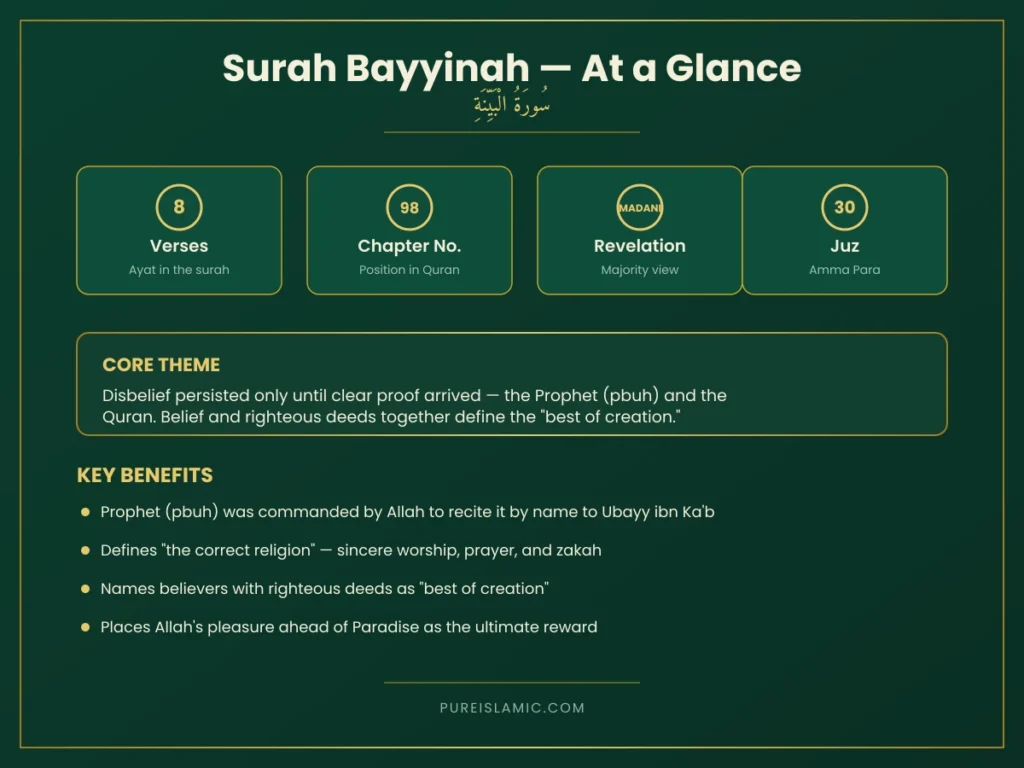
Frequently Asked Questions About Surah Bayyinah
What is Surah Bayyinah about? Surah Bayyinah (Chapter 98) explains that disbelief among the People of the Book and polytheists persisted only until clear proof—Prophet Muhammad ﷺ and the Quran—reached them, after which people divided into believers and disbelievers.
How many verses does Surah Bayyinah have? Surah Al-Bayyinah has 8 verses, located in Juz 30.
Is Surah Bayyinah Makki or Madani? Most scholars classify it as Madani, revealed after the migration to Madinah, though a minority hold it was revealed in Makkah—its classification is contested.
Why was Surah Bayyinah revealed? It was revealed to explain that continued disbelief among the People of the Book and polytheists was no longer due to unclear guidance—the Prophet ﷺ and the Quran had already delivered clear, final proof.
What does “Bayyinah” mean? “Bayyinah” means “clear evidence” or “clear proof,” referring in this surah to Prophet Muhammad ﷺ and the Quran he recited.
What are the benefits of Surah Bayyinah? It is uniquely recorded in Sahih al-Bukhari and Sahih Muslim as a surah the Prophet ﷺ was commanded by Allah to recite by name to his companion Ubayy ibn Ka’ b.
What does “best of creation” mean in Surah Bayyinah? Verse 7 describes those who believe and do righteous deeds as “the best of creatures” (khayr al-bariyyah)—one of the highest descriptions given to any group in the Quran.
What is “deen al-qayyimah” mentioned in Surah Bayyinah? It means “the correct” or “upright religion,” defined in verse 5 as sincere worship of Allah alone, establishing prayer, and giving zakah.
What is the connection between Surah Al-Qadr, Surah Bayyinah, and Surah Az-Zalzalah? Surah Al-Qadr describes the night the Quran’s revelation began; Surah Bayyinah describes the clear proof that revelation delivered; and Surah Az-Zalzalah describes the Day of Judgment when every response to that proof is accounted for.
Can Surah Bayyinah be recited in daily prayers? Yes — like other short surahs, it can be recited in any rak’ah of prayer.
What are the benefits of Surah Bayyinah in Urdu? سورۃ البینہ کی فضیلت یہ ہے کہ نبی کریم ﷺ کو اللہ نے حکم دیا کہ وہ یہ سورت حضرت اُبی بن کعب رضی اللہ عنہ کو نام لے کر پڑھ کر سنائیں۔ یہ سورت سیدھے دین کی تعریف بھی بیان کرتی ہے۔
Related Articles on PureIslamic.com
- Surah Alaq: Arabic, Translation, Tafsir & Lessons
- Surah Kafiroon: Arabic, Translation, Tafsir & Lessons
- How to Pray Namaz: A Complete Step-by-Step Guide
- How to Perform Wudu (Complete Guide)
- 10 Important Daily Duas Every Muslim Should Know
- Dua After Salah: Complete Adhkar Guide
Sources & References
- The Holy Quran, Surah Al-Bayyinah 98:1–8 — Quran.com
- Tafsir Ibn Kathir, Surah Al-Bayyinah — Quran.com
- Tafsir Ibn Kathir, full commentary — Abdurrahman.org
- Surah Al-Bayyinah — MyIslam.org, background and classification notes
- Al-Bayyina — Wikipedia, structure and classification overview
- Sahih al-Bukhari and Sahih Muslim (narration of the Prophet ﷺ reciting this surah by name to Ubayy ibn Ka’ b)
- Surah Al-Qadr 97:1–5 and Surah Az-Zalzalah 99:1–8 (Quran.com)—for surah placement and connection
Written by: Abdul Wahab Reviewed by: Hafiz Muneer Afridi Last reviewed: August 1, 2026
Disclaimer: This article is intended for general knowledge and educational purposes only. Readers are encouraged to consult a qualified scholar for in-depth religious rulings or personal guidance.